


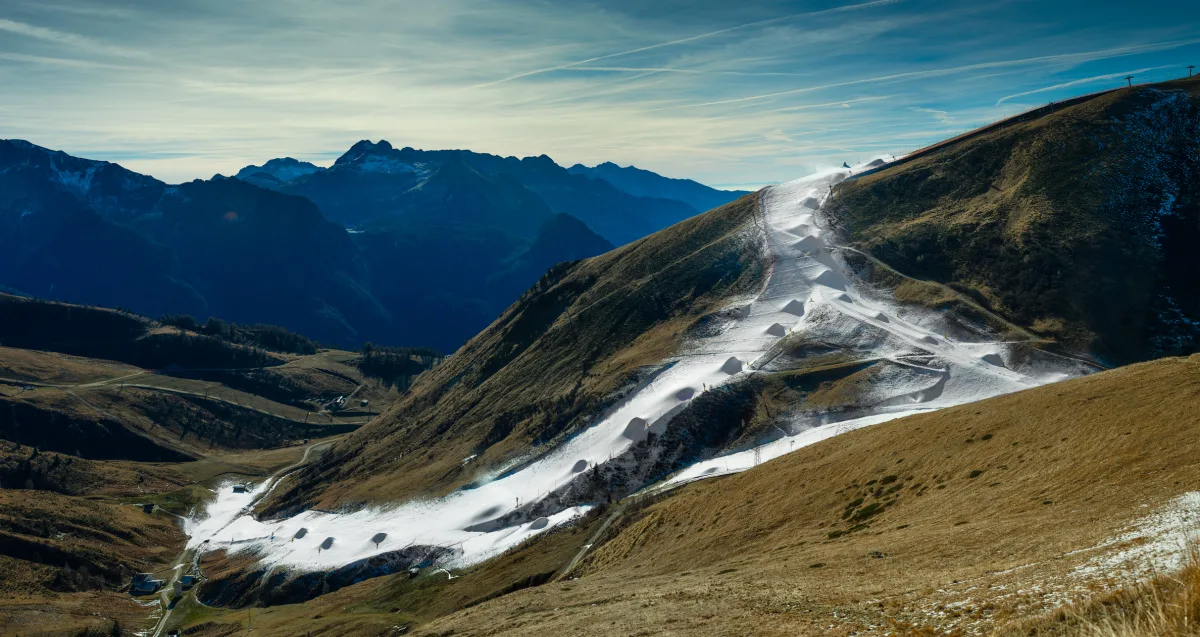
The pushing and shoving started shortly after lunchtime. Hundreds of skiers at Arabba-Marmolada in the Italian Dolomites found themselves stranded at 2,300 metres when the downhill slope beneath them turned to mud and grass in above-average temperatures. The closure forced everyone to queue for a single ski lift back down the mountain. As the crowd swelled, frustration boiled over. Skiers jostled and shoved their way towards the front. The scene lasted for hours before the throng finally dispersed.
Arabba-Marmolada had seemed a safe bet. Its altitude typically guarantees snow, or at least the artificial variety pumped out by snow cannons. But with temperatures hovering above zero in early December, the cannons stood silent. They only function below freezing. The millions spent on snowmaking infrastructure proved utterly useless.
The Arabba chaos offers a succinct summary of skiing’s predicament this winter. Europe’s snowpack hovers at just 66 per cent of normal, whilst much of the American Rockies remains stubbornly brown. Fewer than half of Switzerland’s slopes are open. Eager skiers crowd onto threadbare ribbons of artificial snow cutting through otherwise naked mountainsides—when the artificial snow works at all.
The desperate scramble to manufacture winter reveals an industry at war with itself. Rather than confronting an existential crisis, ski resorts double down on the very response that hastens their demise. An industry dependent on cold weather burns through energy and water at unprecedented rates to recreate what nature increasingly refuses to provide.
A death spiral on ice
Vail Resorts, which operates Vail, Breckenridge, and other major North American destinations, reported an eight per cent decline in visits across the 2023-24 season following a 28 per cent drop in snowfall. The company’s response? More snow guns. Machines that once assisted 41 per cent of ski areas across the American Midwest and Northeast now prop up 89 per cent across the country.
Each snow gun devours huge amounts of water and electricity. Covering a medium-sized ski slope 1,600 metres long requires up to 20,000 cubic metres of water. American resorts consume anywhere from 50 to 400 million gallons of water annually for snowmaking. Between October and January, 67 per cent of a typical resort’s energy consumption goes to artificial snow production. In US regions already grappling with water insecurity—New Mexico, Colorado, Wyoming—snowmaking represents what researchers politely term ‘maladaptation’: industry jargon for digging one’s grave with borrowed shovels.
The environmental cost creates a vicious feedback loop. Most resorts still run their snow guns on fossil fuels, pumping carbon dioxide into an atmosphere already warm enough to melt their product. Snowmaking machines use approximately 478,000 megawatt-hours of electricity annually, resulting in 130,095 tonnes of CO2 emissions—equivalent to the annual energy consumption of nearly 17,000 households. The industry is quite literally melting its own business model.
The surrender of low ground
Some resorts have already conceded defeat. In France alone, more than 180 ski resorts have shuttered since the 1970s. Grand Puy in Seyne-les-Alpes exemplifies the trend. The French Alpine resort saw skier days plummet from 17,000 in the 2013-14 season to just 6,000 a decade later. Locals voted 71 per cent in favour of closure, preferring to sell off snow guns and groomers rather than haemorrhage public cash into an impossible fight. The chairlift that ferried skiers to 1,800 metres for 65 years now sits idle, a monument to optimism meeting thermodynamics.
The economic carnage extends far beyond lift tickets. The US ski industry collectively lost five billion US dollars from 2000-2019 as a result of climate change. Projections suggest annual losses ranging from 657 million to 1.35 billion US dollars by the 2050s under even a low-emissions scenario, rising to 27-62 billion US dollars under business-as-usual warming. The average ski season in the US has already shortened by five-seven days since 2000, with the number expected to double or triple by 2050.
The delusion of the high ground
Industry optimists point to altitude as salvation. High-elevation resorts in Idaho and the Austrian Alps boast they can weather the warming. They’re half right. The Alps have already warmed by two per cent over the past century—about twice the global average—with snow depth reduced by nearly 10 per cent since the 1970s and snow-cover duration declining by more than five per cent per decade over the past 50 years. The ski season is now a month shorter than in the 1970s.
Even Switzerland’s loftiest resorts feel the squeeze. Fewer than half the country’s slopes are open in late December, with many areas seeing little fresh snow through the month. The freezing level regularly reaches 2,500 metres in the afternoon—hardly ideal when your business model depends on frozen water at precisely those altitudes.
The snowmaking arms race merely postpones the inevitable whilst inflating costs. Artificial snow production expenses run from 1,257 US dollars per acre in the Pacific Northwest to 2,673 US dollars per acre in the Northeast. On any given day, a resort can spend anywhere from 200 to 1,000 US dollars per inch of artificial snow. Small independent operators cannot match the deep pockets of conglomerates like Vail, which can balance poor winters in Colorado against decent conditions in Australia.
The result is consolidation: fewer, larger, more expensive resorts serving an increasingly elite clientele.
The pivot that isn’t
Faced with existential threat, some resorts have embraced year-round diversification. Mountain biking trails. Zip lines. Wedding venues. Summer hiking. All meant to reduce dependence on fickle snowfall. Sounds sensible. Isn’t enough.
This is not, however, a sustainable solution. Skiers buy expensive lift passes and often rent equipment, bringing in substantially more revenue than hikers and cyclists. Without skiing, there’s precious little to draw people to the mountains in winter—the season that historically generated the bulk of annual income. Summer activities help. But they don’t replace the winter bonanza that made mountain towns viable in the first place.
Alpine ski resorts receive up to 80 million tourists per year and turn over nearly 30 billion euros in revenue, with about half a million French jobs dependent on the industry. Converting that economic engine to hikers armed with packed lunches would require a transformation so profound that it amounts to abandoning the business entirely.
Some resorts are attempting more creative reinvention. A handful have invested in ‘snow farming’—collecting and storing snow from previous winters in insulated structures for use during lean months. Finnish, Swedish, and Swiss operations have pioneered the technique, though its scalability remains questionable. Others are experimenting with advanced climate forecasting to maximise the brief windows when temperatures drop low enough for snowmaking. These are, at best, tactical adaptations to a strategic collapse.
The reality no one wants to ski
The fundamental problem is that ski resorts are trying to solve a thermodynamics challenge with technology. You cannot indefinitely pump water uphill to freeze it on mountainsides that are warming faster than the global average. A Swiss study from 2017 estimated that, depending on emissions reductions, snow cover in the Alps will decline by 30 to 70 per cent by century’s end. Even with artificial snowmaking, 53 to 98 per cent of the 2,234 ski resorts studied across 28 European countries face high risk for snow supply in the future.
The 2022 Beijing Winter Olympics offered a glimpse of skiing’s dystopian future: the first Games to use nearly 100 per cent artificial snow, held in a region that had no business hosting winter sports. If that represents the industry’s peak achievement, it rather proves the critics’ point.
What genuine reinvention might look like remains unclear. The sensible response—acknowledging that many current ski destinations will become unviable and planning accordingly—requires a degree of honesty that threatens property values, municipal budgets, and corporate earnings in the near term. Far easier to buy another snow gun, schedule another artificial blizzard, and hope that next winter brings real snow.
It won’t. The climate data is unambiguous. Virtually all locations are projected to see reductions in winter recreation season lengths. The industry can choose to manage its decline intelligently, finding new purposes for mountain infrastructure and communities. Or it can burn through billions on artificial snow whilst the glaciers melt and the season shrinks.
Current trends suggest the latter. After all, it’s hard to pivot when you’re going so quickly downhill.
Photo: Dreamstime.