


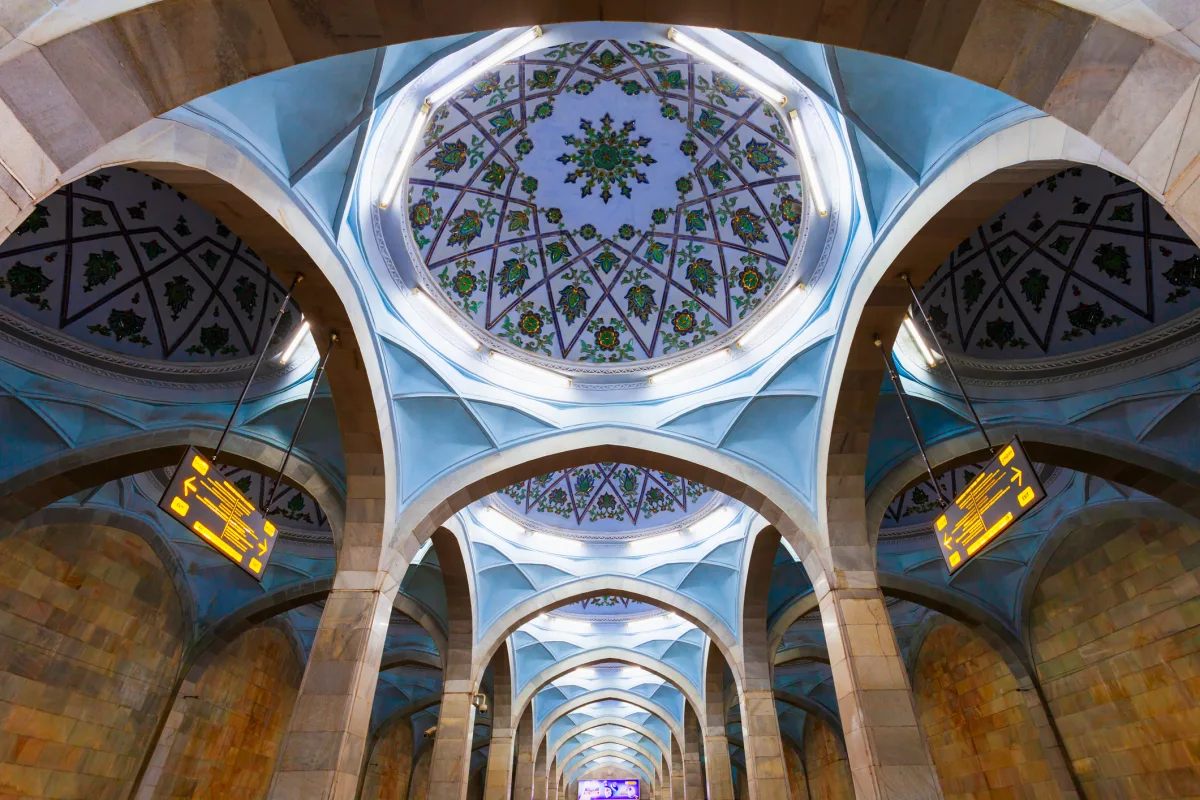
Tashkent’s metro is one of the most spectacular underground railways in the world. For visitors, alas, taking photos of its many impressive stations was forbidden until as recently as 2018. Since then, the evidence of its splendour has done as much for Uzbek tourism as Registon Square in Samarkand, or the walls of Bukhara.
When President Islam Karimov died in September 2016, the question was not what he would leave behind (the answer to that was well-documented) but whether Uzbekistan could become anything other than the heavily policed, economically stagnant pariah state he had fashioned over 26 years. His successor, Shavkat Mirziyoyev, had been prime minister for 13 of those years. Optimism was in short supply. Would-be photographers of Tashkent’s metro did not hold their breath.
A decade on, that pessimism looks, at least in economic terms, misplaced. Uzbekistan is now one of the fastest-growing economies in Europe and Central Asia, its GDP surpassing 145 billion US dollars in 2025, a figure that, as Mirziyoyev reminded parliament in December, was once considered a distant aspiration. The economy grew by 7.7 per cent last year, its strongest performance since 2021. Exports have risen by 23 per cent to 33.4 billion US dollars. Foreign direct investment hit a record 10 billion US dollars in 2024. The IMF credits reforms with setting off a “virtuous cycle of higher investment, growth, and poverty reduction”. Rating agencies have taken notice too, upgrading the country’s sovereign credit rating from BB- to BB, a move expected to cut external borrowing costs by up to 250 million euros a year.
The big bang of 2017
The foundations of what Mirziyoyev has built rest on a single, consequential decision taken in his first year. Under Karimov, Uzbekistan maintained an official exchange rate that bore no resemblance to reality. Currency conversion was restricted, imports were controlled and the borders with neighbouring Kazakhstan, Kyrgyzstan and Tajikistan were sporadically closed. Visitors and locals exchanged money on the street or not at all. In 2017, Mirziyoyev unified the exchange rate at a stroke, lifted currency restrictions and simplified customs and tax rules. It was the kind of reform that takes political courage and a willingness to accept short-term pain, and it worked. The World Bank now counts Uzbekistan as its third-largest client in Europe and Central Asia, with commitments of over 4.65 billion US dollars across 23 active projects.
The trade-to-GDP ratio has more than doubled since 2017, reaching 71.6 per cent by 2022. Remittances (mostly from Uzbek workers in Russia, Turkey and South Korea) jumped 27 per cent year-on-year in the first half of 2025, to around 8.2 billion US dollars, providing a surge of household consumption that has helped keep growth buoyant despite global turbulence. WTO accession, long deferred, is targeted for this year, a marker of how far the country has travelled from Karimov’s autarkic instincts.
Cotton fields and tourists
One of the most striking changes has been the abolition of forced labour in the cotton sector, a practice so entrenched under Karimov that it had become synonymous with the country itself.
For decades, Uzbekistan mobilised schoolchildren, teachers and civil servants to pick cotton each autumn, under threat of losing their jobs or places at school. In 2022, international boycotts were lifted after the Cotton Campaign and the United States government certified that systematic forced labour had ended.
That certification carried real economic weight: international brands and retailers, many of which had avoided Uzbek cotton for years, could now return. The country is rebuilding its textile sector on rather different terms than before.
Few shifts have been more visible than tourism. UN Tourism data show that Uzbekistan’s international arrivals in the first nine months of 2025 were 73 per cent above pre-pandemic 2019 levels, placing the country among the top seven fastest-growing destinations worldwide.
The total topped 10.7 million visitors in the first 11 months of 2025, generating an estimated 3.74 billion euros in tourism export revenues. Mirziyoyev extended visa-free access to citizens of nearly 100 countries, rebuilt airports, opened the ancient Silk Road cities of Samarkand, Bukhara and Khiva to international hotel brands and promoted the country at trade fairs across 21 markets simultaneously.
Chinese arrivals are expected to have grown fivefold compared with 2023. JW Marriott and Swissôtel have both opened properties in Tashkent. Tourism, once unimaginable as a significant economic sector, is now a pillar of the country’s national strategy through 2030. Photos of the Tashkent metro are now positively encouraged.
The limits of the miracle
None of this makes Uzbekistan a democracy. Mirziyoyev has used largely reform to consolidate power, not share it. A 2023 constitutional referendum (passed, the government claims, with 90.2 per cent of the vote) extended the presidential term from five to seven years and reset the clock on his tenure, potentially keeping him in office until 2037. No real opposition exists. The judiciary remains an instrument of the executive. The Human Rights Watch annual report for 2025 documented intensifying persecution of critical bloggers as well as the continued use of psychiatric detention against regime critics. In February 2025, two men (one a human rights activist, the other a blogger) reportedly died while in custody.
Then there is Karakalpakstan. In July 2022, protests erupted in the autonomous western region after Mirziyoyev’s government proposed constitutional amendments that would have stripped the region of its right to hold an independence referendum. At least 21 people were killed (opposition figures put the number considerably higher) and over 270 were injured. The security forces used lethal force. The president withdrew the amendments and flew to Nukus, but what followed was a sustained crackdown on dissent in the region that continues today.
The economy itself has structural weaknesses Mirziyoyev has been reluctant to address. The state still controls around 65 per cent of the banking sector and holds stakes in major firms including UzAuto Motors and Uzbekneftegaz. External debt reached 64.1 billion US dollars in 2024, or 55.7 per cent of GDP, rising. Job creation has lagged badly: average employment growth of just 1.1 per cent annually over the last five years, against a population growing at two per cent and a net working-age increase of 250,000 per year. Power shortages remain a chronic irritant for households and businesses alike, the product of decades of underinvestment in a grid that cannot keep pace with growth.
The template, such as it is
What, then, can countries emerging from authoritarian rule learn from Uzbekistan? The first lesson is sequencing: Mirziyoyev moved fastest on reforms that were economically consequential but politically safe, such as currency liberalisation, trade opening, tourism promotion, while keeping political competition firmly off the table. Whether that sequencing is replicable is contested. It has generated growth and foreign goodwill without destabilising the ruling elite. But it has also created a class of connected insiders who benefit disproportionately from the opening-up, and the World Bank has flagged that four out of five state-owned enterprises operate in sectors where private firms could compete more effectively. The privatisation agenda, in other words, has been selective.
The second lesson is international optics. Mirziyoyev understood that ending forced cotton labour, which cost nothing in economic terms but was symbolically enormous, would transform the country’s reputation in Western markets overnight. Similarly, hosting the EU-Central Asia Summit in Samarkand in April 2025 and pushing hard for WTO membership were not merely economic decisions. They were signals of intent to the world, designed to attract capital and lock in the reform trajectory.
The third lesson is more uncomfortable. Uzbekistan has managed a decade of accelerating growth without meaningfully liberalising its politics. That may be of comfort to autocrats elsewhere who believe economic reform and political control can coexist indefinitely. Whether Mirziyoyev has proved that point, or is simply accumulating the contradictions that will eventually force a reckoning, with rising expectations from a more educated, connected, travelling middle class colliding with an authoritarian ceiling, is the question that will define the next decade.
The next ten years
The government has set a target of 240 billion US dollars in GDP by 2030. The pace of growth makes it conceivable. Mirziyoyev himself told parliament that an interim target of 160 billion US dollars, once pegged to 2030, would be reached as early as this year. But the country needs sustained reform of its energy sector, a genuine assault on the state’s grip over the economy, and an employment-rich model of growth rather than one driven by capital investment and remittances. That requires institutional capacity and rule of law that remain largely absent.
The reinvention of Uzbekistan over the past decade is real, significant and worth studying. A country that was largely closed to the world when Karimov died now hosts over ten million tourists a year. Its sovereign credit rating has been upgraded. The IMF visits and lavishes praise. The EU holds summits. What has not changed is power: who holds it, how it is exercised, and who pays the price for questioning it. In Karakalpakstan, that particular gap between the Uzbekistan of the travel brochures and the Uzbekistan of lived experience remains, a decade on, wide.
Photo: Dreamstime.