




Earlier this week in Addis Ababa, I gave a keynote that sparked more conversations than I expected. Not because it offered a flattering script. Quite the opposite. It challenged one of the most comfortable assumptions in economic development: that if a country gets the familiar basics right—talent, location, incentives—investment will follow, and relevance will take care of itself. The room suggested otherwise. Policymakers know, even if they do not always say it aloud, that the old playbook is starting to fray.
For years, countries have competed on a familiar formula. Be well positioned. Offer cost-efficient labour. Create attractive incentives. In a slower world, that was sensible. Stability lasted longer. Supply chains moved less. Business models did not morph every other budget cycle. But that was a different rhythm, and policy built for a slower rhythm tends to look sturdy right up until it starts to look dated.
Competing for relevance
The real change is this: the clock that governs companies now governs countries too. If firms are reinventing themselves every 12 to 36 months, then the environments in which they operate are being judged by a much harsher standard. Not simply, Are you open for business? but, Can you evolve as fast as the business I am becoming? That is why countries are no longer merely competing for attention. They are competing for relevance.
That shift matters because it changes what investors are really choosing. Under continuous reinvention, companies are not simply choosing locations. They are choosing adaptive ecosystems. They are looking for environments that are not only future-ready, with the infrastructure, skills and policy foundations to operate today, but future-relevant: able to reposition, reskill and reconfigure before disruption forces them to. That is a much higher bar. It is also a much more useful one.
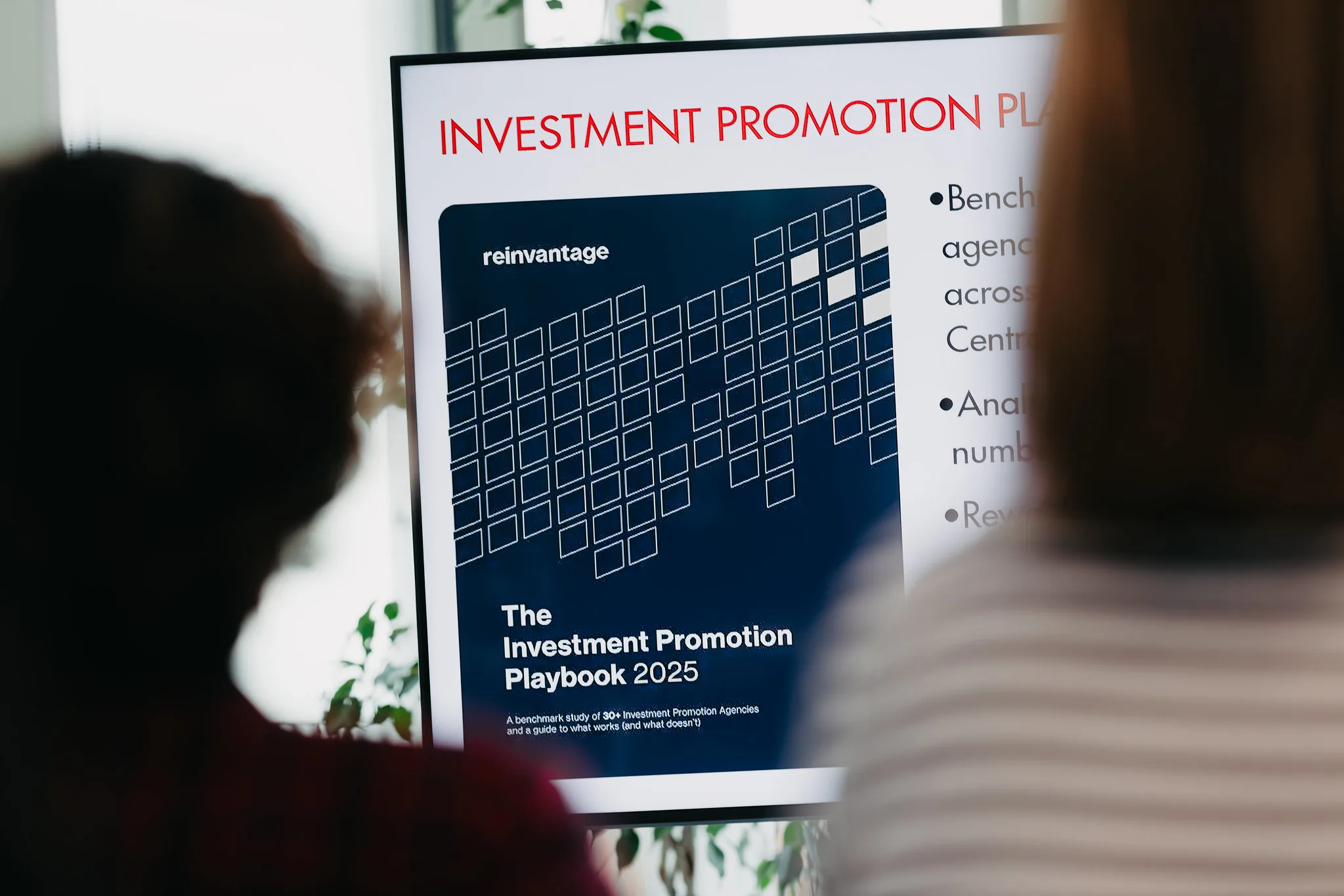
The Investment Promotion Playbook
Which means policymakers should ask slightly more uncomfortable questions. If automation reduces labour intensity but raises value per worker, why are incentives still so often tied to headcount? If digital infrastructure, cyber resilience and data governance increasingly shape boardroom decisions, why do some national strategies still talk as if proximity alone will do the heavy lifting? If the workforce is being hired into jobs that will be redesigned within two years, why are talent systems still built for yesterday’s demand rather than tomorrow’s ambiguity? Your answer to each of those questions reveals whether policy is attracting entry or accelerating evolution.
Designing for a compressed world
This is where the conversation becomes more interesting, especially for so-called late movers. Much commentary treats them as laggards in need of catching up. But that misses the strategic opportunity. Places still building parts of their industrial, digital and educational architecture carry a rare advantage: they can design with the compressed world in mind. They are not always trapped by legacy systems, legacy incentives or legacy assumptions built for a more patient age. Properly understood, building later is not a handicap. It can be structural freedom.
That freedom matters because it allows for something richer than imitation. It allows for leap design. Education can be aligned to emerging demand rather than historic prestige. Incentives can reward learning velocity, technology adoption and capability density, not just square metres and payroll counts. Policy can favour embedded experimentation over bureaucratic theatre. Strategy can be built around coherence rather than fragmentation. None of this is automatic, of course. Late building does not guarantee smart building. But it does offer the chance to design for adaptability from the outset.
And that, increasingly, is the dividing line. Cost may still attract entry. But capability secures permanence. A country becomes truly competitive not when it appears on the shortlist, but when its absence would be felt. Not when investors notice it, but when they would genuinely miss it. That is the test policymakers should use now. Not visibility, but indispensability. Not readiness alone, but relevance that endures. In the next decade, the winners will not simply be the places that grow. They will be the places that keep redesigning their value as growth itself changes shape.