


crime
The crimes we can’t yet imagine
ectogenesis
A womb of one’s own?
parallax background

Last resort

Ski slopes are melting. The industry's response is making things worse

December 29, 2025

7 min read

December 29, 2025

7 min read

Photo: Dreamstime.

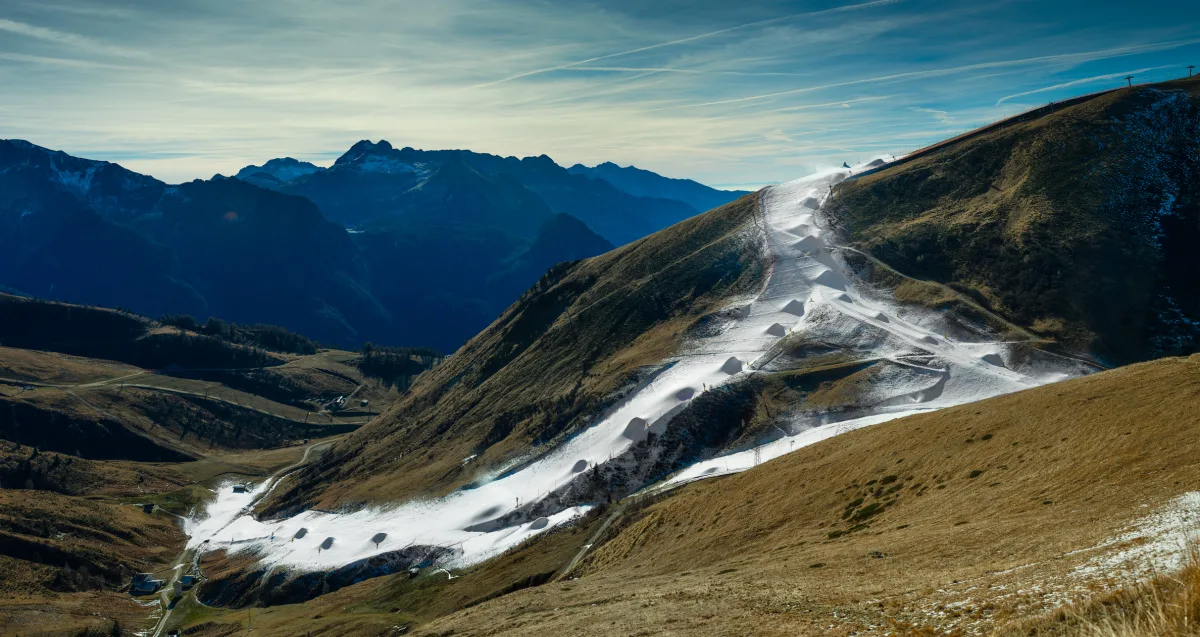
The pushing and shoving started shortly after lunchtime. Hundreds of skiers at Arabba-Marmolada in the Italian Dolomites found themselves stranded at 2,300 metres when the downhill slope beneath them turned to mud and grass in above-average temperatures. The closure forced everyone to queue for a single ski lift back down the mountain. As the crowd swelled, frustration boiled over. Skiers jostled and shoved their way towards the front. The scene lasted for hours before the throng finally dispersed.

Arabba-Marmolada had seemed a safe bet. Its altitude typically guarantees snow, or at least the artificial variety pumped out by snow cannons. But with temperatures hovering above zero in early December, the cannons stood silent. They only function below freezing. The millions spent on snowmaking infrastructure proved utterly useless.

The Arabba chaos offers a succinct summary of skiing’s predicament this winter. Europe’s snowpack hovers at just 66 per cent of normal, whilst much of the American Rockies remains stubbornly brown. Fewer than half of Switzerland’s slopes are open. Eager skiers crowd onto threadbare ribbons of artificial snow cutting through otherwise naked mountainsides—when the artificial snow works at all.

The desperate scramble to manufacture winter reveals an industry at war with itself. Rather than confronting an existential crisis, ski resorts double down on the very response that hastens their demise. An industry dependent on cold weather burns through energy and water at unprecedented rates to recreate what nature increasingly refuses to provide.

A death spiral on ice

Vail Resorts, which operates Vail, Breckenridge, and other major North American destinations, reported an eight per cent decline in visits across the 2023-24 season following a 28 per cent drop in snowfall. The company’s response? More snow guns. Machines that once assisted 41 per cent of ski areas across the American Midwest and Northeast now prop up 89 per cent across the country.

Each snow gun devours huge amounts of water and electricity. Covering a medium-sized ski slope 1,600 metres long requires up to 20,000 cubic metres of water. American resorts consume anywhere from 50 to 400 million gallons of water annually for snowmaking. Between October and January, 67 per cent of a typical resort’s energy consumption goes to artificial snow production. In US regions already grappling with water insecurity—New Mexico, Colorado, Wyoming—snowmaking represents what researchers politely term ‘maladaptation’: industry jargon for digging one’s grave with borrowed shovels.

The environmental cost creates a vicious feedback loop. Most resorts still run their snow guns on fossil fuels, pumping carbon dioxide into an atmosphere already warm enough to melt their product. Snowmaking machines use approximately 478,000 megawatt-hours of electricity annually, resulting in 130,095 tonnes of CO2 emissions—equivalent to the annual energy consumption of nearly 17,000 households. The industry is quite literally melting its own business model.

The surrender of low ground

Some resorts have already conceded defeat. In France alone, more than 180 ski resorts have shuttered since the 1970s. Grand Puy in Seyne-les-Alpes exemplifies the trend. The French Alpine resort saw skier days plummet from 17,000 in the 2013-14 season to just 6,000 a decade later. Locals voted 71 per cent in favour of closure, preferring to sell off snow guns and groomers rather than haemorrhage public cash into an impossible fight. The chairlift that ferried skiers to 1,800 metres for 65 years now sits idle, a monument to optimism meeting thermodynamics.

The economic carnage extends far beyond lift tickets. The US ski industry collectively lost five billion US dollars from 2000-2019 as a result of climate change. Projections suggest annual losses ranging from 657 million to 1.35 billion US dollars by the 2050s under even a low-emissions scenario, rising to 27-62 billion US dollars under business-as-usual warming. The average ski season in the US has already shortened by five-seven days since 2000, with the number expected to double or triple by 2050.

The delusion of the high ground

Industry optimists point to altitude as salvation. High-elevation resorts in Idaho and the Austrian Alps boast they can weather the warming. They’re half right. The Alps have already warmed by two per cent over the past century—about twice the global average—with snow depth reduced by nearly 10 per cent since the 1970s and snow-cover duration declining by more than five per cent per decade over the past 50 years. The ski season is now a month shorter than in the 1970s.

Even Switzerland’s loftiest resorts feel the squeeze. Fewer than half the country’s slopes are open in late December, with many areas seeing little fresh snow through the month. The freezing level regularly reaches 2,500 metres in the afternoon—hardly ideal when your business model depends on frozen water at precisely those altitudes.

The snowmaking arms race merely postpones the inevitable whilst inflating costs. Artificial snow production expenses run from 1,257 US dollars per acre in the Pacific Northwest to 2,673 US dollars per acre in the Northeast. On any given day, a resort can spend anywhere from 200 to 1,000 US dollars per inch of artificial snow. Small independent operators cannot match the deep pockets of conglomerates like Vail, which can balance poor winters in Colorado against decent conditions in Australia.

The result is consolidation: fewer, larger, more expensive resorts serving an increasingly elite clientele.

The pivot that isn’t

Faced with existential threat, some resorts have embraced year-round diversification. Mountain biking trails. Zip lines. Wedding venues. Summer hiking. All meant to reduce dependence on fickle snowfall. Sounds sensible. Isn’t enough.

This is not, however, a sustainable solution. Skiers buy expensive lift passes and often rent equipment, bringing in substantially more revenue than hikers and cyclists. Without skiing, there’s precious little to draw people to the mountains in winter—the season that historically generated the bulk of annual income. Summer activities help. But they don’t replace the winter bonanza that made mountain towns viable in the first place.

Alpine ski resorts receive up to 80 million tourists per year and turn over nearly 30 billion euros in revenue, with about half a million French jobs dependent on the industry. Converting that economic engine to hikers armed with packed lunches would require a transformation so profound that it amounts to abandoning the business entirely.

Some resorts are attempting more creative reinvention. A handful have invested in ‘snow farming’—collecting and storing snow from previous winters in insulated structures for use during lean months. Finnish, Swedish, and Swiss operations have pioneered the technique, though its scalability remains questionable. Others are experimenting with advanced climate forecasting to maximise the brief windows when temperatures drop low enough for snowmaking. These are, at best, tactical adaptations to a strategic collapse.

The reality no one wants to ski

The fundamental problem is that ski resorts are trying to solve a thermodynamics challenge with technology. You cannot indefinitely pump water uphill to freeze it on mountainsides that are warming faster than the global average. A Swiss study from 2017 estimated that, depending on emissions reductions, snow cover in the Alps will decline by 30 to 70 per cent by century’s end. Even with artificial snowmaking, 53 to 98 per cent of the 2,234 ski resorts studied across 28 European countries face high risk for snow supply in the future.

The 2022 Beijing Winter Olympics offered a glimpse of skiing’s dystopian future: the first Games to use nearly 100 per cent artificial snow, held in a region that had no business hosting winter sports. If that represents the industry’s peak achievement, it rather proves the critics’ point.

What genuine reinvention might look like remains unclear. The sensible response—acknowledging that many current ski destinations will become unviable and planning accordingly—requires a degree of honesty that threatens property values, municipal budgets, and corporate earnings in the near term. Far easier to buy another snow gun, schedule another artificial blizzard, and hope that next winter brings real snow.

It won’t. The climate data is unambiguous. Virtually all locations are projected to see reductions in winter recreation season lengths. The industry can choose to manage its decline intelligently, finding new purposes for mountain infrastructure and communities. Or it can burn through billions on artificial snow whilst the glaciers melt and the season shrinks.

Current trends suggest the latter. After all, it’s hard to pivot when you’re going so quickly downhill.

Photo: Dreamstime.

Craig Turp-Balazs

Craig Turp-Balazs

Craig Turp-Balazs is head of insight and analysis at Reinvantage.

Share

Case study: Global technology company

1. The Client

A global technology company operating across EMEA, with a regional HQ in Istanbul. The company manages 20+ markets, handling everything from brand campaigns to strategic partnerships.

Role we worked with: The EMEA Head of Marketing (supported by two regional managers).

2. The Challenge

Despite strong products and a respected global brand, the regional team was struggling with:

  • Misaligned strategy across markets → campaigns executed with inconsistent narratives.
  • Slowed growth → lead generation plateaued despite increasing spend.
  • Internal friction → marketing, sales, and product teams disagreed on KPIs and priorities.

Traditional fixes (more meetings, more reporting) only created more noise.

3. The Sprint

We ran a 10-day Remote Reinvention Sprint with the regional HQ team.

  • Day 1–3: Intake → Reviewed decks, campaign data, and plans.
  • Day 4: Sprint Session (90 mins) → Breakthroughs:
    • Sales and marketing had different definitions of “qualified lead.”
    • 40% of spend was going into low-potential markets.
    • The team assumed the problem was lack of budget, but it was actually lack of alignment.
  • Day 5–10: Synthesis → Insights distilled into a Clarity Brief + Insight Canvas.
4. The Breakthrough

The Sprint uncovered that the issue wasn’t budget, but fragmentation.
Three sharp insights unlocked a way forward:

  1. Unified KPIs bridging marketing + sales.
  2. Market prioritisation → shifting budget to 5 high-potential markets.
  3. Simplified narrative → one EMEA core story, locally adaptable.
By just realigning resources and focus, the client could unlock an estimated £250,000 in efficiency gains within the next 12 months — far exceeding the Sprint’s value guarantee. The path to higher returns was already inside the business, hidden by misalignment.
5. From Sprint to Action (4 Pillars Applied)

With clarity secured, Reinvantage didn’t suggest “more projects.”

Instead, we used the Sprint findings to create laser-focused next steps — drawing only from the areas that would deliver the most impact:

  • Readiness → Alignment workshops for sales + marketing teams. New playbooks clarified “qualified lead” definitions and reduced internal disputes.
  • Foresight → A market-opportunity scan identified which 5 countries would deliver the highest ROI, removing the guesswork from allocation.
  • Growth → Guided the reallocation of €2M budget and designed a phased rollout strategy that protected risk while maximising return.
  • Positioning → Built a messaging framework balancing global consistency with local nuance, ensuring campaigns spoke with one clear voice.

Because the Sprint had stripped away noise, these actions weren’t generic consulting ideas — they were directly tied to the breakthroughs.

6. The Results
  • +28% increase in qualified leads across the region.
  • 30% faster campaign rollout due to streamlined approvals.
  • Budget efficiency gains → €2M redirected from low-return to high-potential markets.
  • Internal cohesion → marketing + sales now use a single shared dashboard.
The client came in believing they needed more budget.
The Sprint revealed that what they really needed was clarity and alignment.

With that clarity, the four pillars became not theory, but practical tools to deliver measurable impact.

The Sprint guaranteed at least £20,000 in value — but in this case, it helped unlock more than 10x that within six months.

Case study: Regional VC fund & accelerator

1. The Client

A regional venture capital fund and accelerator focused on early-stage tech start-ups in the Baltics and Central Europe.

The fund had raised a new round and was under pressure to deliver stronger returns while also building its reputation as the go-to platform for founders.

Role we worked with: Managing Partner, supported by the Head of Portfolio Development.

2. The Challenge

Despite a promising portfolio, results were uneven.

Key issues:

  • Scattered portfolio support → no consistent playbook for start-ups, every partner did things differently.
  • Weak differentiation → founders and co-investors saw the fund as “one of many” in the region.
  • Stretched team → too many small bets, not enough clarity on which companies to double down on.

The leadership team knew something was off, but disagreed on whether the issue was pipeline quality, market conditions, or internal capacity.

3. The Sprint

We ran a 10-day Remote Reinvention Sprint with the partners and portfolio team.

  • Day 1–3: Intake → Reviewed pitch decks, pipeline funnel data, and start-up performance reports.
  • Day 4: Sprint Session (90 mins) → Breakthroughs:
    • No shared definition of a “high-potential founder.”
    • Support resources were spread too thin across the portfolio.
    • The fund’s positioning was more reactive than proactive — it didn’t own a distinctive narrative in the market.
  • Day 5–10: Synthesis → Insights consolidated into a Clarity Brief + Insight Canvas.
4. The Breakthrough

The Sprint revealed that the challenge wasn’t pipeline quality — it was lack of focus and positioning.

Three core insights provided the turning point:

  1. Portfolio Prioritisation Framework → defined clear criteria for where to double down.
  2. Founder Success Playbook → standardised support model for portfolio companies.
  3. Differentiated Narrative → repositioned the fund as “the accelerator of reinvention-ready founders.”
These shifts alone gave the fund a path to add an estimated £2M+ in portfolio value over the following 18 months, by concentrating capital and resources where they could move the needle most.
5. From Sprint to Action (4 Pillars Applied)

With clarity from the Sprint, Reinvantage created a tailored support plan:

  • Readiness → Coached partners on using the new prioritisation framework and trained the team on deploying the Founder Success Playbook.
  • Foresight → Ran scenario analysis on regional tech trends, helping the fund anticipate where capital would flow next.
  • Growth → Guided resource reallocation across the portfolio and supported new co-investor pitches for top-performing start-ups.
  • Positioning → Crafted a sharper brand story for the fund, positioning it as the reinvention partner for globally minded founders.
6. The Results
  • 10 portfolio companies onboarded to the new Playbook → greater consistency of support.
  • Raised follow-on capital for 3 top start-ups with the new prioritisation framework.
  • +26% increase in inbound deal flow from founders citing the fund’s new positioning.
  • Stronger internal cohesion → partners aligned on where to focus resources.
The client thought the problem was pipeline quality.
The Sprint showed it was actually lack of clarity and focus inside the firm.

By applying the four pillars, Reinvantage helped turn scattered effort into concentrated value creation.

The Sprint guaranteed at least £20,000 in value; here it set the stage for multi-million-pound upside in portfolio growth.

Case study: International impact Organisation

1. The Client

A large international impact organisation focused on entrepreneurship and economic empowerment.
The organisation runs multi-country programmes across Eastern Europe and Central Asia, often in partnership with global donors and corporate sponsors.

Role we worked with: Senior Programme Director, responsible for regional coordination.

2. The Challenge

The organisation had launched a flagship regional initiative supporting women entrepreneurs, but the programme was underperforming.

Key issues:

  • Fragmented delivery → each country office interpreted the programme differently.
  • Donor frustration → reporting lacked consistency and clear impact metrics.
  • Lost momentum → staff energy was spent on administration rather than scaling success stories.

Traditional programme reviews had produced long reports, but no real alignment or action.

3. The Sprint

We ran a 10-day Remote Reinvention Sprint with the regional leadership team and representatives from two country offices.

  • Day 1–3: Intake → Reviewed donor reports, programme KPIs, and field feedback.
  • Day 4: Sprint Session (90 mins) → Breakthroughs:
    • Donors cared about quantifiable outcomes, but reporting focused on stories.
    • Staff were duplicating efforts across countries, wasting time and resources.
    • The initiative lacked a clear theory of change — everyone described its purpose differently.
  • Day 5–10: Synthesis → Insights distilled into a Clarity Brief + Insight Canvas.
4. The Breakthrough

The Sprint revealed that the issue wasn’t donor pressure or programme design — it was a lack of shared framework and alignment.

Three critical insights reshaped the path forward:

  1. One Unified Theory of Change → agreed narrative for why the programme exists.
  2. Core Impact Metrics → clear, comparable KPIs across all countries.
  3. Smart Resource Sharing → digital hub to stop duplication and accelerate knowledge flow.
By eliminating duplicated reporting and clarifying what success looks like, the client saw they could save the equivalent of £100,000 in staff time annually — while also unlocking stronger donor confidence and follow-on funding opportunities.
5. From Sprint to Action (4 Pillars Applied)

Armed with Sprint clarity, Reinvantage proposed a laser-focused support plan:

  • Readiness → Trained programme leads on using the new metrics and integrated them into existing workflows.
  • Foresight → Analysed donor trends and expectations, aligning the initiative with the next funding cycle.
  • Growth → Developed a funding case based on the new unified theory of change, securing higher renewal chances.
  • Positioning → Crafted a regional success narrative and storytelling toolkit, helping them showcase results consistently across markets.
6. The Results
  • 30% less time spent on reporting → freed capacity for programme delivery.
  • Donor satisfaction improved → positive feedback on the clarity of impact evidence.
  • Secured new funding commitment → one major donor increased their contribution by 20%.
  • Stronger internal morale → staff felt they were working with clarity, not chaos.
The client thought it needed better donor management.
The Sprint revealed it needed a shared foundation across its teams.

By anchoring on the four pillars, Reinvantage turned alignment into efficiency gains and fresh funding opportunities.

The Sprint guaranteed at least £20,000 in value; here it unlocked both six-figure savings and future-proofed funding.

Case study: National digital development agency

1. The Client

A national digital development agency tasked with driving the government’s digital transformation agenda, including e-services, citizen portals, and smart city pilots.

Role we worked with: Director of Digital Transformation, supported by IT and service delivery leads from three ministries.

2. The Challenge

The agency had strong political backing but faced hurdles in implementation.

Key issues:

  • Siloed projects → each ministry developed digital tools independently, leading to duplication.
  • Citizen frustration → services were digital in name, but still required multiple logins and offline steps.
  • Funding pressure → international partners demanded clearer impact in the short term.

The agency wanted to accelerate momentum but struggled to get alignment across ministries.

3. The Sprint

We ran a 14-day Immersive Reinvention Sprint with the agency’s leadership and digital focal points from three ministries.

  • Day 1–3: Intake → Reviewed strategy docs, donor reports, and citizen feedback data.
  • Day 4: Immersive Sprint Session (half-day) → Breakthroughs:
    • Each ministry had different definitions of “digital service.”
    • 20% of budget was going into overlapping pilot projects.
    • Citizens’ top frustrations were known — but not prioritised.
  • Day 5–14: Synthesis → Insights consolidated into a Clarity Brief + Insight Canvas.
4. The Breakthrough

The Sprint revealed that the biggest blocker wasn’t lack of funding, but lack of shared priorities.

Three practical insights stood out:

  1. One Definition of Digital Service → agreed across ministries.
  2. Quick-Win Prioritisation → focus on top 3 citizen pain points (ID renewal, business registration, healthcare booking).
  3. Shared Resource Map → pool budgets to eliminate duplication.
These changes alone allowed the agency to unlock £75,000 in immediate savings and deliver 2–3 visible improvements in the next quarter — meeting donor expectations and building citizen trust.
5. From Sprint to Action (4 Pillars Applied)

Based on the Sprint clarity, Reinvantage proposed a modest, targeted package of support:

  • Readiness → Facilitated inter-ministerial workshops to embed the “one digital service” definition.
  • Foresight → Analysed citizen feedback trends to shape the quick-win roadmap.
  • Growth → Supported the reallocation of funds to joint projects, reducing overlap.
  • Positioning → Crafted a communication plan highlighting early digital wins to donors and citizens.
6. The Results
  • 2 pilot services integrated into the central portal (ID renewal + healthcare booking).
  • Budget savings of £75,000 from eliminating overlapping projects.
  • Citizen satisfaction up modestly → call centre complaints on digital services dropped by 12%.
  • Donor confidence improved → short-term impact report received positive feedback.
The client thought it needed more funding and bigger projects.
The Sprint revealed it first needed clarity and alignment.

By applying the four pillars to a targeted scope, Reinvantage helped deliver visible results within a single quarter — proving progress to citizens and donors and laying the groundwork for deeper transformation.

You must be logged in to view this page. Login here.

Bridging the Reinvention Gap: Fill this form and get your preview copy immediately.

Future of IT: Fill this form and get your preview copy immediately.

War for Talent: Fill this form and get your copy immediately.

The Voice of Ukrainian Start-ups: Fill this form and get your copy immediately.

The uncounted engine: Ukraine’s start-up rise. Fill this form and get your copy immediately.

The Investment Promotion Playbook 2025: Fill this form and get your preview copy immediately.

The Reinvention Masterclass for Start-up Founders: Join the private cohort

Beyond Borders: Join the private edition