



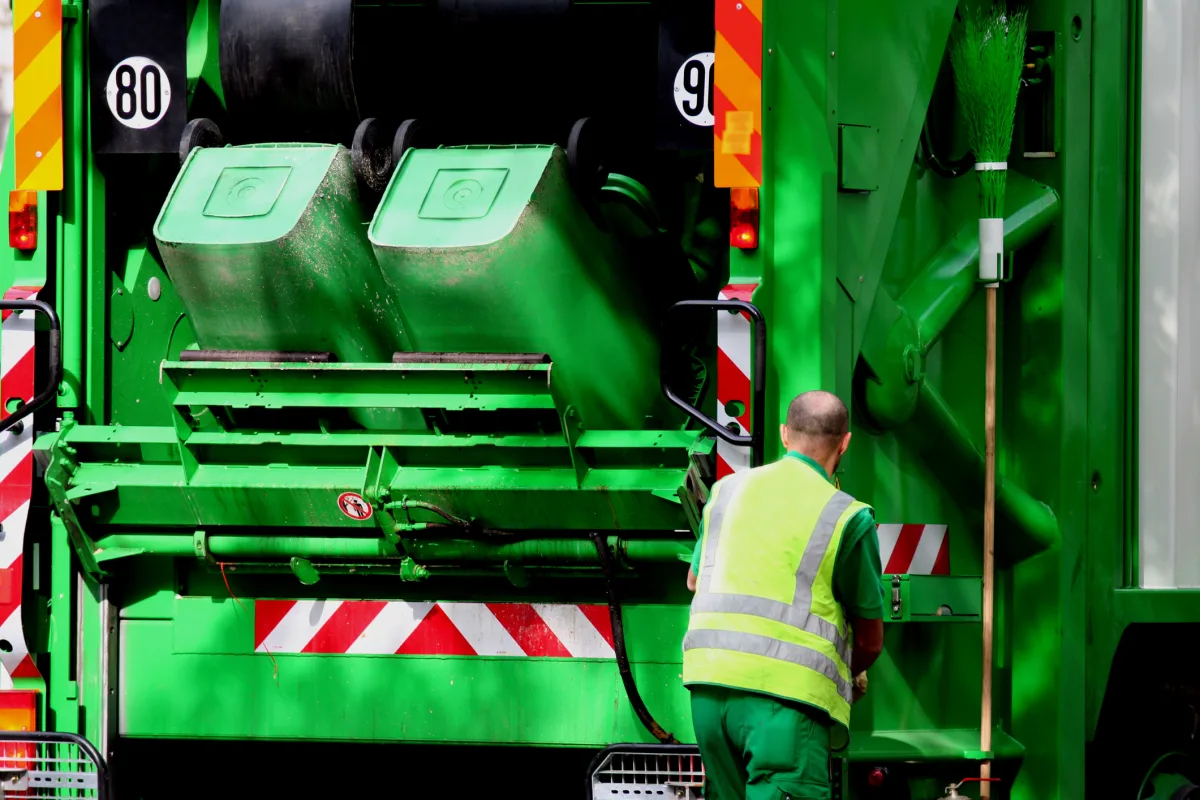
The first household waste bills landed in Cotonou on January 19. The Société de Gestion des Déchets et de la Salubrité du Grand Nokoué (SGDS-GN), Benin’s state-owned cleansing company, began distributing invoices that day across five municipalities including the country’s economic capital, asking residents to bring identification to collection points to register. José Tonato, Benin’s minister of living conditions, has been pushing for this moment for some time. Until then, garbage trucks rumbled through Cotonou and nobody paid for them directly. The trucks now carry GPS units that cost the state around 465 US dollars to fit and 23 US dollars a month to run. Annual collection has risen from 430,000 to 470,000 tonnes, and landfill trips have fallen by around 500 a year. The customer database that made the invoices possible was built from the routing data those GPS units generated.
Kremena Ionkova, who leads the World Bank’s work on solid waste and circularity, spoke at the Asia Smart City Conference in Yokohama in November 2025 about the kind of bootstrapping Cotonou represents. She co-authored a report from the International Finance Corporation, published last month, that documents more than a dozen similar cases. Global municipal solid waste will grow to 3.9 billion tonnes by 2050, up from 2.6 billion in 2022. In poorer countries the volume will more than double. Open dumping and burning already cost an estimated 361 billion US dollars a year in health and environmental damage.
Seoul offers the longest-running illustration. South Korea banned food waste from landfills in 2005 and rolled out radio-frequency identification (RFID) bins that weigh each household’s discarded food and charge accordingly. Food waste recycling has risen from roughly two per cent in 1995 to about 98 per cent in 2023, according to figures cited by the Frost & Sullivan Institute. A Seoul pilot of smart bins cut collection frequency by 66 per cent and lowered costs by 83 per cent. Oh Se-hoon, the city’s mayor, is now trying to extract a further round of gains. In December the Seoul Metropolitan Government announced a food waste reduction points scheme that rewards households cutting their output by between 10 and 30 per cent with around 5,000 won (about four US dollars) per evaluation period. In late January 2026 Oh launched a separate ‘Separation and Discharge Pledge Challenge’ aimed at collecting 100,000 commitments from residents and district heads.
Sok Lu, the governor of Battambang province, told reporters in March 2024 that more than half the city’s residents still did not pay for garbage collection. “People think it is small,” he said of the rubbish problem, “but this is not small.” Cambodia’s environment ministry had launched a national digital waste platform in his province in August 2023, operated by a local firm called Luma. It paired digital billing and mobile payments with GPS tracking. Alexander Nash, an ADB senior urban specialist, has said in interviews about the project that the share of Battambang households paying for collection has climbed from roughly 40 per cent before the launch to between 75 and 80 per cent today.
Sorting it out
Maryam Nawaz Sharif, Punjab’s chief minister, inspected new loaders, trucks and e-bikes at the Lahore Expo Centre on in December 2024, when she launched a province-wide cleanliness drive called Suthra Punjab. The system she announced relies heavily on IoT sensors and fleet analytics built by the Lahore Waste Management Company (LWMC) under its CEO, Babar Sahib Din; the IFC’s report cites LWMC figures showing fuel use down 29 per cent, maintenance costs down 18 per cent and route efficiency up 32 per cent against pre-digital baselines. Pakistani journalists have not been universally impressed. A Daily Times piece in November 2025 noted that despite a provincial budget of 150 billion rupees, 21,000 deployed vehicles and a stated target of zero waste in three months, Punjab’s streets were still patchily served a year on from launch.
Ionkova and her co-authors are careful to flag what can go wrong. Pilots not measured against a baseline are often abandoned when budgets tighten, they warn, and municipalities which procure integrated platforms before fixing their data flows end up with expensive software they cannot use. The IFC recommends a sequence: identify the specific problem, build staff capacity, integrate any new tool with the platforms already in use, then phase in a wider rollout. The list of recommended quick wins in the report (digital billing, GPS fleet tracking, route optimisation, digitised weighbridges and citizen engagement apps) is meant to be tackled in that order. Continuous engagement with citizens and businesses runs throughout.
Barcelona’s city hall announced in March that it would launch a fresh plan, with more than 150 measures, to overhaul cleaning and waste collection in Ciutat Vella, the city’s medieval district. The Catalan capital already runs RFID-enabled bins, underground pneumatic collection and performance-based contracts that allow contractors to be monitored against agreed indicators in real time. Its solar-powered self-compacting bins empty at roughly an eighth of the cost of conventional ones, according to the IFC. Even so, the city said in its announcement, overflow was still piling up in the narrow streets of the old town, and service quality in the area had fallen behind the rest of the city.
Photo: Dreamstime.