

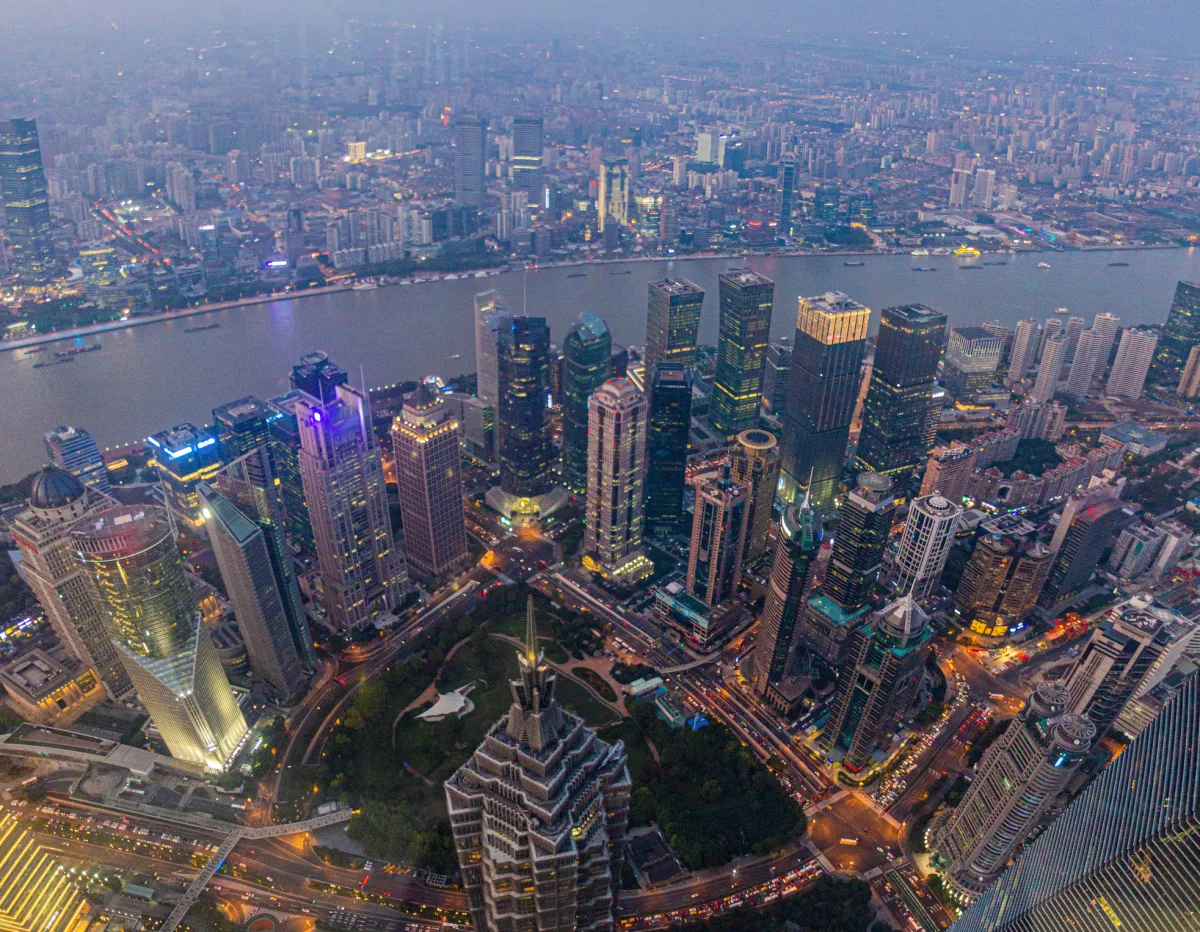
As the world’s cities compete ever more openly for talent, capital, innovation and influence, a new model of metropolitan development is taking shape before our eyes. It is larger than a city, more integrated than a conventional region, and increasingly capable of bending national—and even global—economic trajectories to its own logic. Few places illustrate this transformation more vividly than Shanghai.
For three decades, Shanghai’s ascent served as shorthand for China’s opening and its integration into world markets. That chapter is essentially complete. Today the city is pursuing a more ambitious objective: to reinvent itself as the core of a next-generation metropolitan ecosystem capable of standing alongside—and in several respects ahead of—the most advanced urban regions on earth. The story is therefore no longer one of urban growth in the familiar sense. It is a study in how great cities reinvent themselves in an age defined by technological disruption, demographic pressure, climate stress and geopolitical uncertainty. For policymakers, executives and investors far beyond China, that may prove to be Shanghai’s most exportable lesson.
Beyond the city: The rise of the megaregion
Traditional measures of urban success fixate on the city itself (its population, its GDP, its infrastructure, its skyline). Increasingly, however, competitiveness is being decided at a different scale altogether. The world’s most dynamic economic centres are no longer individual cities but interconnected metropolitan ecosystems: Greater Tokyo, the San Francisco Bay Area, the Boston–Washington corridor in the United States, the Rhine–Ruhr conurbation in Germany. Each demonstrates that the relevant unit of competition has quietly migrated from the municipality to the network.
Shanghai is taking this logic to its furthest expression. The city sits at the heart of the Yangtze River Delta, a vast economic region that knits together Suzhou, Hangzhou, Nanjing, Ningbo, Wuxi and Hefei, among others, into a single productive fabric. Encompassing Shanghai together with the provinces of Jiangsu, Zhejiang and Anhui, the Delta is home to roughly 235 million people—close to half the population of the entire European Union—concentrated on barely four per cent of China’s land. Its combined output reached an estimated 4.65 trillion US dollars in 2024, second only to the Boston–Washington megalopolis, and accounting for about a quarter of China’s total GDP and close to thirty percent of its growth. Were it a sovereign state, it would rank among the largest economies on the planet.
The significance lies less in the headline figures than in the shift they signal. The Delta is increasingly behaving as one integrated economic system rather than a loose confederation of cities, with coordinated planning, shared infrastructure and pooled innovation capacity. Nine of its cities now command economies exceeding one trillion yuan, and its research intensity—R&D as a share of output—climbed to 3.34 per cent in 2023. The conclusion for any region with global ambitions is uncomfortable but clarifying: the future of competitiveness may depend far less on how successful a single city becomes than on how intelligently it connects, coordinates and compounds with the region around it.
Shanghai’s reinvention and its Asian century and global ambitions
Shanghai’s transformation has moved through three distinct phases, each more demanding than the last. The first was built on manufacturing and trade, the engine of the early reform era. The second established the city as China’s financial gateway to the world, the place where global capital met Chinese ambition. The third phase, now well advanced, is qualitatively different. Its centre of gravity is innovation—advanced manufacturing, artificial intelligence, biotechnology, green technology, digital governance and high-value services—and its instruments are not factories but ecosystems.
Districts such as Pudong, Zhangjiang and Lingang were not conceived as business parks in the conventional mould. They were engineered as innovation ecosystems, deliberate environments in which research institutions, technology firms, universities, investors and entrepreneurs are made to collide within a coordinated framework. This is reinvention by design rather than by accident, and it reflects a reality now confronting cities everywhere: economic success can no longer rest on physical infrastructure or industrial capacity alone. Durable competitiveness flows from the capacity to attract talent, generate ideas and adapt at the speed of technological change itself.
Shanghai is not merely China’s most cosmopolitan city or its richest; it is the instrument through which a rising power intends to demonstrate that modernity, openness and global leadership can be exercised on Chinese terms—the showcase that the Chinese model works at the highest level of the world economy. China positions Shanghai as the rising star of the Asian Century and a runner-up to the title of the world’s greatest city, matching in the future New York and London.
The Shanghai 2035 vision
What distinguishes Shanghai is not merely the direction of travel but the discipline of the map. The Shanghai Master Plan 2017–35, approved by the State Council, sets out the ambition of becoming an “excellent global city” by 2035, with a longer horizon extending to 2050, and positions Shanghai explicitly as the core of the world-class Yangtze River Delta cluster—a centre of international economy, finance, trade, shipping and technological innovation. Crucially, the plan trades the old reflex of unbounded expansion for deliberate restraint: the city’s permanent population is to be capped at around 25 million, and the land allocated for construction is held flat, even projected to contract. Growth, in other words, is to be qualitative rather than quantitative.
The plan recognises a dilemma now shared by cities across the world. Growth alone is no longer sufficient. Urban leaders are expected to reconcile economic performance with environmental sustainability, social inclusion, mobility, resilience and quality of life—objectives that frequently pull against one another. Shanghai 2035 is an attempt to hold all of them within a single development model, complete with measurable targets, including a striking ambition to lift the contribution of research and development toward the level of the most innovation-intensive economies. Whether every target is met is, in a sense, beside the point. The deeper lesson is methodological: serious metropolitan regions increasingly require planning horizons that outlast electoral cycles and ride above short-term economic weather. Continuity of strategy is itself a competitive asset.
Shanghai and Tokyo: A new metropolitan competition
Comparisons between Shanghai and Tokyo are inevitable, and largely beside the point. Tokyo remains the world’s largest metropolitan area and one of the most sophisticated urban systems ever built; its infrastructure, governance and quality of life continue to define the global benchmark. The more revealing contrast, however, is not between the two cities but between the metropolitan systems that surround them—and here the asymmetry becomes strategic.
Tokyo anchors the economy of a country in demographic contraction, its population ageing and shrinking in ways that constrain even the most accomplished urban machine. Shanghai sits at the centre of the Yangtze River Delta, among the most dynamic economic regions anywhere. Whether Shanghai’s metropolitan population overtakes Tokyo’s by 2040 or 2050 is ultimately a secondary question. The decisive one is whether the Yangtze River Delta emerges as the single most influential urban-economic ecosystem of the century. On a widening range of indicators—infrastructure investment, manufacturing sophistication, logistics connectivity, innovation capacity and sheer economic dynamism—the region is already positioning itself as the leading contender; its Shanghai–Suzhou and Nanjing clusters now rank among the world’s top ten science and technology hubs in the Global Innovation Index.
The implication reframes the entire contest. The competition of the coming decades may not be city against city. It may be megaregion against megaregion — and the players who fail to grasp that shift will be optimising at the wrong scale.
Lessons for emerging metropolises
Shanghai’s experience carries practical weight for fast-growing urban regions across Central and Eastern Europe, Southeast Asia, the Gulf, Africa and Latin America—and the lessons are unusually portable. The first is to think beyond administrative boundaries. Competitiveness is increasingly a function of regional integration, not municipal performance in isolation; the city that hoards advantage rather than networking it will be outpaced by the region that pools it. The second is that infrastructure remains the precondition for everything else. Digital transformation delivers its full return only when it rests on world-class transport, logistics, energy and connectivity—the unglamorous foundations on which knowledge economies are actually built.
The third lesson is that innovation cannot be decreed in isolation; it must be cultivated as an ecosystem that binds together education, research, entrepreneurship, capital and international talent in sustained proximity. The fourth is that sustainability should be read not as a cost but as a source of durable advantage. The most attractive cities of the coming generation will be those that can combine economic growth with resilience and a high quality of life — increasingly the true currency in the global competition for mobile talent. And the final lesson, perhaps the hardest for governments organised around short cycles, is that transformation requires continuity. Reinvention is rarely the product of a single project or a single mandate. It is a long process, sustained across decades, protected from the temptations of expediency.
The future of global cities
The twenty-first century is becoming, in earnest, an age of metropolitan competition. Cities and regions now contend for investment, talent, innovation and influence in ways once reserved for nation states — and they increasingly win or lose on the same terms. Shanghai’s evolution demonstrates that scale alone is insufficient. The cities and regions that will thrive are those capable of continuous adaptation while holding to a coherent strategic direction, marrying restlessness with discipline.
That is the deeper meaning of Shanghai’s Megacity 2.0. The future will not belong to the biggest cities, but to the cities—and the regions around them—best able to reinvent themselves. In Shanghai, and across the Yangtze River Delta it anchors, that reinvention is already well underway. The relevant question for everyone else is whether they are competing at the same scale, with the same horizon, and with the same nerve. Reinvention under competition is key.
Photo: Dreamstime.