


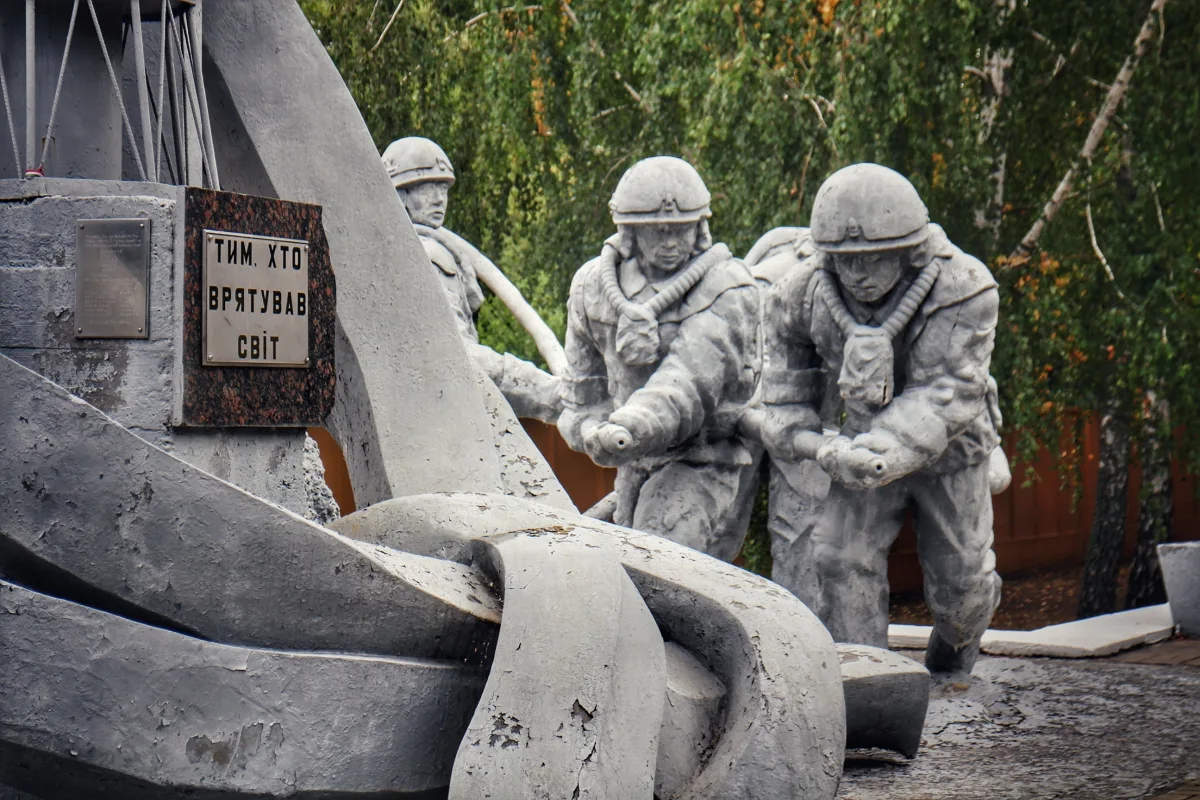
Stanislav Tolumnyi is 65. Last week he walked back through the gates of the Chernobyl nuclear power station, four decades after arriving there for the first time as a young firefighter. The Associated Press photographed him and four other liquidators (Mykola Chudak, Viktor Hluhovtsov, Anatolii Taranenko, Serhii Buriak) returning to the site they had helped decontaminate in 1986. Pripyat, the purpose-built Soviet town next door, has stood empty since its evacuation on April 27, 1986. The 40th anniversary of the accident fell on Sunday.
What happened at 01:23 on April 26, 1986, is by now well-trodden ground. A safety test on Unit 4 went off-script. Operators had disabled several protection systems; the RBMK-1000 reactor’s positive void coefficient and poorly designed graphite-tipped control rods did the rest. Two workers died in the initial explosion and 28 more, mostly firefighters, died of acute radiation syndrome within three months. The United Nations in 2005 estimated eventual radiation-related deaths at around 4,000 across the most exposed cohorts of liquidators, evacuees and residents. Some 350,000 people were moved out of a 30-kilometre exclusion zone that is still in place today.
Today, the site itself is a masterwork of international civil engineering. The New Safe Confinement (a 257-metre-wide steel arch, the largest movable land structure ever built) was slid over the Soviet-era sarcophagus in November 2016 and formally handed to Ukraine in July 2019. The French consortium Novarka, led by VINCI and Bouygues, built it. The 2.1 billion euros Shelter Implementation Plan was financed through the Chernobyl Shelter Fund, managed by the European Bank for Reconstruction and Development (EBRD), with contributions from 45 donor countries and 480 million euros of the EBRD’s own money.
Then, in February 2025, a Russian drone hit the roof. The strike opened a 15 square metre hole in the outer cladding and damaged roughly 200 square metres of wider area. In December the International Atomic Energy Agency announced that the NSC had “lost its primary safety functions”. The EU, Britain and France have pledged an initial 42.5 million euros towards repairs; the final bill may reach 500 million euros.
Safety first
The political half-life of Chernobyl has proved longer than the radiological one. Italy held a referendum in November 1987, the year after the accident, and shuttered its reactors within three years. Austria never commissioned the one it had built at Zwentendorf. Germany’s Energiewende, two decades of anti-nuclear politics and Angela Merkel’s post-Fukushima volte-face in 2011 produced the final switch-off: on April 15, 2023 the reactors at Emsland, Isar 2 and Neckarwestheim 2 went dark, ending six decades of German atomic power.
All of which was, on the numbers, a strange decision. Nuclear is the second-safest way to generate a unit of electricity (solar is the safest). Even accounting for the death tolls of both Chernobyl and Fukushima, Our World in Data puts nuclear at roughly 0.03 deaths per terawatt-hour; coal sits at 24.6. The lignite plants backfilling the gap left by the German reactor closures have added, by one estimate, some 36 million tonnes of CO2 a year and 1,100 premature deaths annually from air pollution. Chernobyl’s most dangerous legacy may not be the fuel rods still locked under the arch, but the plants Europe chose not to build.
Minds are changing. Fatih Birol, the head of the International Energy Agency, told the Associated Press this week that he was “100% sure nuclear is coming back”. Over 400 reactors are running across 31 countries; roughly 70 more are under construction. Washington wants to quadruple American nuclear capacity by 2050. Friedrich Merz’s coalition in May 2025 abandoned Berlin’s long-standing objection to nuclear being treated as equivalent to renewables in EU climate policy. The Italian parliament in February 2025 approved a law to begin unwinding its 1987 ban.
Are SMRs the future?
The glossy bit of the comeback is the small modular reactor, or SMR (factory-built, 77 to 470 megawatts, siteable on decommissioned coal land). Rolls-Royce SMR signed a contract in late 2025 with Great British Energy Nuclear for three units at Wylfa on Ynys Môn; in January 2026 it appointed Amentum as programme delivery partner for its first deployments in Britain and Czechia. NuScale, the American firm whose VOYGR design was the first to win Nuclear Regulatory Commission approval, announced a six-gigawatt agreement with the Tennessee Valley Authority in September 2025. Its Romanian project at Doicești, developed with RoPower, is further along than either.
SMRs remain, for now, a PowerPoint technology with a very good press office. France’s EDF abandoned its Nuward design in July 2024 and is redrawing it for the 2030s. Rolls-Royce’s final investment decision is pencilled in for 2029. The first units are unlikely to feed the British grid before the early 2030s, by which time Europe’s carbon budget will be mostly spent.
Back at Chernobyl, the arch sits above what it was designed to contain and a fair bit of what it was not. The drone damage of February 2025 is a reminder that the first-order threat to European civilian nuclear infrastructure is no longer a botched safety test in a shift-tired control room, but a hostile neighbour with a fleet of Shaheds.
Whether the lesson of 1986 is too much caution, too little, or simply the wrong kind altogether is a question Europe will have to answer soon enough. The arch in Ukraine is the monument to one reading. Which reactors get built over the next decade (and which do not) will be the monument to the other.
Photo: Dreamstime.