
Love him or loathe him (and these days it tends to be the latter more than the former), José Mourinho is one of the most successful football coaches of recent decades. He has won league titles in four countries, and is one of only seven coaches to win the European Cup/Champions League with more than one team. His methods and playing style might now be a little outdated, and it’s clear that his best years are behind him, but his place in football’s pantheon is assured.
Self-titled The Special One (an epithet he awarded himself on arrival at Chelsea in 2004), Mourinho’s most fervent critics have long liked to dismiss a man whose own career as a footballer was modest (to say the least) as a glorified interpreter. Mourinho got his break in coaching at Sporting Lisbon in 1992 as an interpreter for Bobby Robson, a strictly monoglot, old school English coach. It was Mourinho’s job to convey Robson’s ideas to Sporting’s (and later Porto’s) players, as well as translate for the Englishman at press conferences. The pair worked well together, and when Robson moved to Barcelona in 1996, he took Mourinho (who also spoke Spanish and Catalan) with him. Robson left after a year, but Mourinho stayed, finally becoming a head coach himself—a ‘mere interpreter’ no more—in 2000, at Benfica.
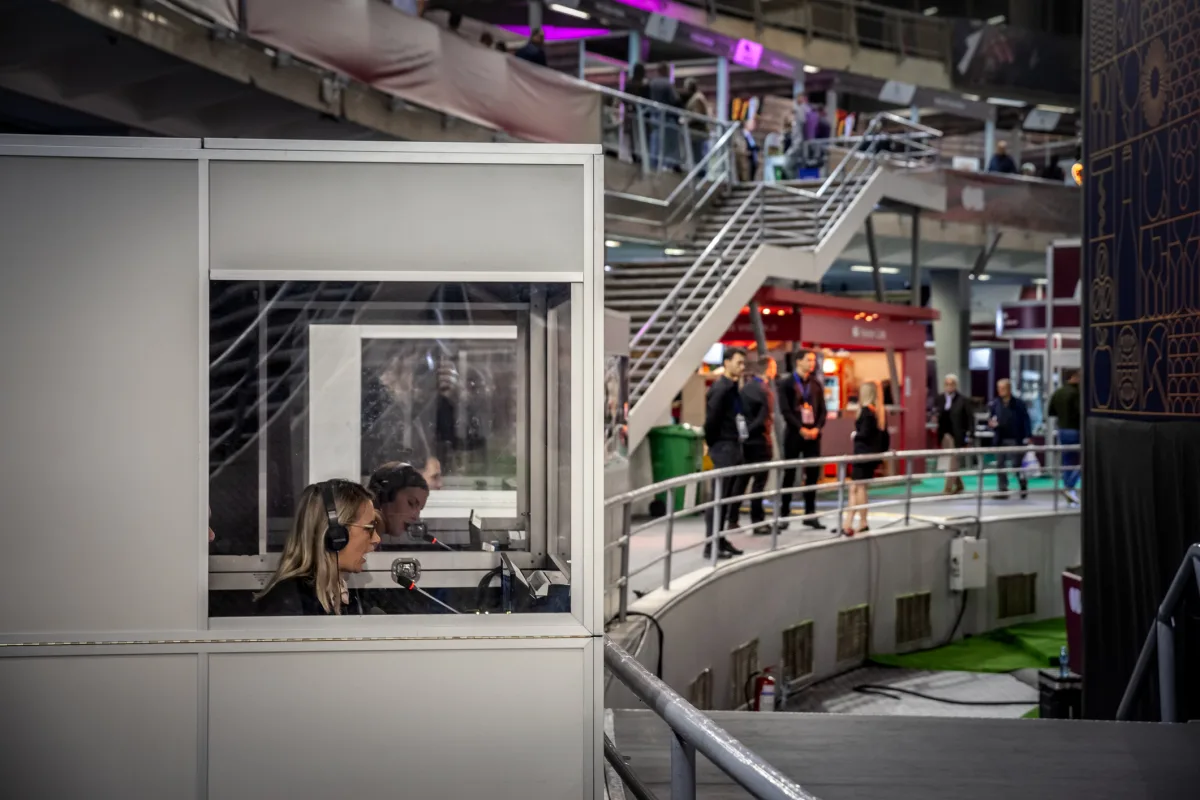
Whatever football fans among the international interpreter community think of Mourinho, there’s no doubt that they would all be appalled at anyone (football coach or otherwise) being pejoratively labelled an interpreter. Imagine a world without them. Even in today’s increasingly international world, where English is spoken by more and more people, the need for interpreters is high. Most do not have the profile of José Mourinho, often doing their jobs tucked away and unseen in little booths, be it at conferences, events, or the European Parliament. For most, sitting next to football coaches at high profile press conferences is not part of the job description.
More than words
As a rule, I will always make a point of thanking interpreters at any event I attend where they are present. I know how difficult a job it is, given that I’ve done it, many years ago interpreting from Romanian to English and vice-versa. It’s hard, mentally exhausting work which is not always well remunerated.
At its core, the job of an interpreter is an act of trust. A diplomat negotiating a trade deal, a CEO closing an acquisition, a surgeon explaining a procedure to a foreign-language patient all place enormous faith in the person doing the interpreting. Not just that they have the vocabulary right, but that they understand the subtext and the cultural weight of what is being said. A mistranslation at a sensitive moment in bilateral talks could derail an entire process. The interpreter who gets it right, invisibly and in real time, deserves considerably more credit than they typically receive.

Beyond Borders™
There is also the sheer physicality of the job that outsiders rarely appreciate. Simultaneous interpreting (where you listen in one language and speak in another, continuously, with a lag of only a few seconds) is one of the most cognitively demanding tasks a human being can perform. Professional interpreters at major conferences typically work in pairs, switching every twenty to thirty minutes, because the mental load is simply too great to sustain for longer.
The AI question
The rise of AI translation tools has prompted many to wonder whether the interpreter’s days are numbered. The short answer is no. The longer answer requires a little nuance.
It is true that machine translation has improved dramatically in recent years. For written content (contracts, reports, correspondence) AI tools can now produce a serviceable first draft in almost any language pair, and a good human editor can tighten it up from there. The technology is genuinely useful. But text translation and live interpretation are not the same discipline, and conflating the two is a mistake.
When two people sit across a table from one another, the words are only part of what is being communicated. Tone matters. Hesitation matters. The slight shift in register when a negotiator moves from cordial to pointed matters enormously. An interpreter reads all of this in real time and calibrates their output accordingly. No current AI system does this reliably. The best can handle clean audio in controlled conditions tolerably well, but put them in a noisy conference room, with overlapping speech, heavy regional accents, and the kind of shorthand that experienced professionals use when they know each other well, and performance drops sharply. More importantly, even where AI handles the words adequately, it strips out the human presence, the reassurance of a skilled professional who is genuinely there in the room, accountable, responsive, and trusted by all parties.
There is also the question of what happens when things go wrong. An AI tool that mishears a word, or misreads a technical term, will proceed with the kind of blind confidence only AI possesses. A human interpreter will pause, ask for clarification, and flag the ambiguity. In the most important settings (legal proceedings, medical consultations, diplomatic exchanges) that difference is not trivial.
Essential, not incidental
None of this is to say that the profession faces no challenges. Rates have been under pressure for years, particularly at the lower end of the market, where clients have grown accustomed to treating interpretation as a commodity. Remote interpreting (yet another trend accelerated by the Covid-19 pandemic) has added flexibility but also introduced new pressures, not all of them comfortable. And yes, for routine, low-stakes exchanges, AI tools will increasingly take on a larger share of the workload. That is simply the direction of travel.
But for the events and interactions that actually matter, the summits, the board meetings, the hearings, the negotiations, the medical emergencies, the sporting occasions where a coach needs to speak directly to a dressing room in another language, interpreters remain indispensable. They are a skilled, trained, irreplaceable part of how the world does its business.
So the next time you are at a conference and notice the booths at the back of the room, it is worth pausing for a moment to appreciate the people inside them. They are, in many respects, the reason the event is possible at all.
Photo: Dreamstime.