


A decade ago, in 2016, publisher Monocle released a giant tome entitled How to Make a Nation. From designing a parliament to choosing a flag and creating social capital, it was a beautifully written (and, as always with Monocle, beautifully illustrated) blueprint for nation builders.
Blueprints, of course, are very much designed with building from scratch in mind. But what about reinvention? How might we reinvent a country—one freshly emerged from war, or dictatorship, for example? Or a country hitherto reliant on fossil fuels that might want to reposition itself as a champion of innovation as opposed to extraction? Manuals for such reinventions are thin on the ground.
It’s often far too easy for writers (such as this correspondent), particularly in the Reinvantage part of the world, to point at Estonia as a model for everything from digitalisation to the creation, almost from scratch, of a world-leading knowledge economy. But there is a very good reason for that, given that few countries in history have managed to reposition themselves any better. Occupied by the Soviet Union for decades, independent Estonia in 1991 had a tiny budget (just 100 million US dollars) but quickly succeeded in developing a functioning democracy, economy, and with its Tiger Leap programme, the digital tools that have since created what is arguably the world’s most digitally-savvy country.
Other countries (many of which were also long occupied by the Soviet Union) have struggled to do so. Some haven’t really tried, others have only recently realised that they need to reinvent themselves to stay competitive. Are there lessons to be learnt from Estonia? Or should such countries seek to create their own models?
Get everyone onside
Political will is where most reinventions stall. It is all very well drawing up blueprints; the harder part is building the political consensus to actually act on them, and then (harder still) sustaining that consensus through electoral cycles. Estonia’s digital revolution worked in part because it was embraced across party lines from the start; no incoming government ever seriously considered unpicking it. The same is broadly true of Poland.
Poland’s Balcerowicz Plan of 1990, the shock therapy that simultaneously liberalised prices, freed the currency and obliterated state subsidies, is perhaps the most instructive case study of what reinvention under political pressure actually looks like. In its first two years GDP shrank by nearly 18 per cent and unemployment leapt from essentially zero to over 12 per cent. The pain was real and the backlash from the Polish public predictable. Nevertheless, no subsequent Polish government ever chose to reverse the fundamentals. By 2023, Polish GDP per capita had grown by 240 per cent in purchasing power parity terms since 1990, outpacing Singapore over the same period. In 2008, alone among EU members, Poland avoided recession altogether.
Hungary meanwhile, once wealthier than Poland on a per capita basis, is the Central European example of reinvention gone wrong. Viktor Orbán’s economic interventionism after 2010 (price controls, aggressive statism, a rolling back of institutional independence) has left Hungary sinking relative to a Poland that stayed the course. Two countries, the same starting point, but very different outcomes. The difference was political will.
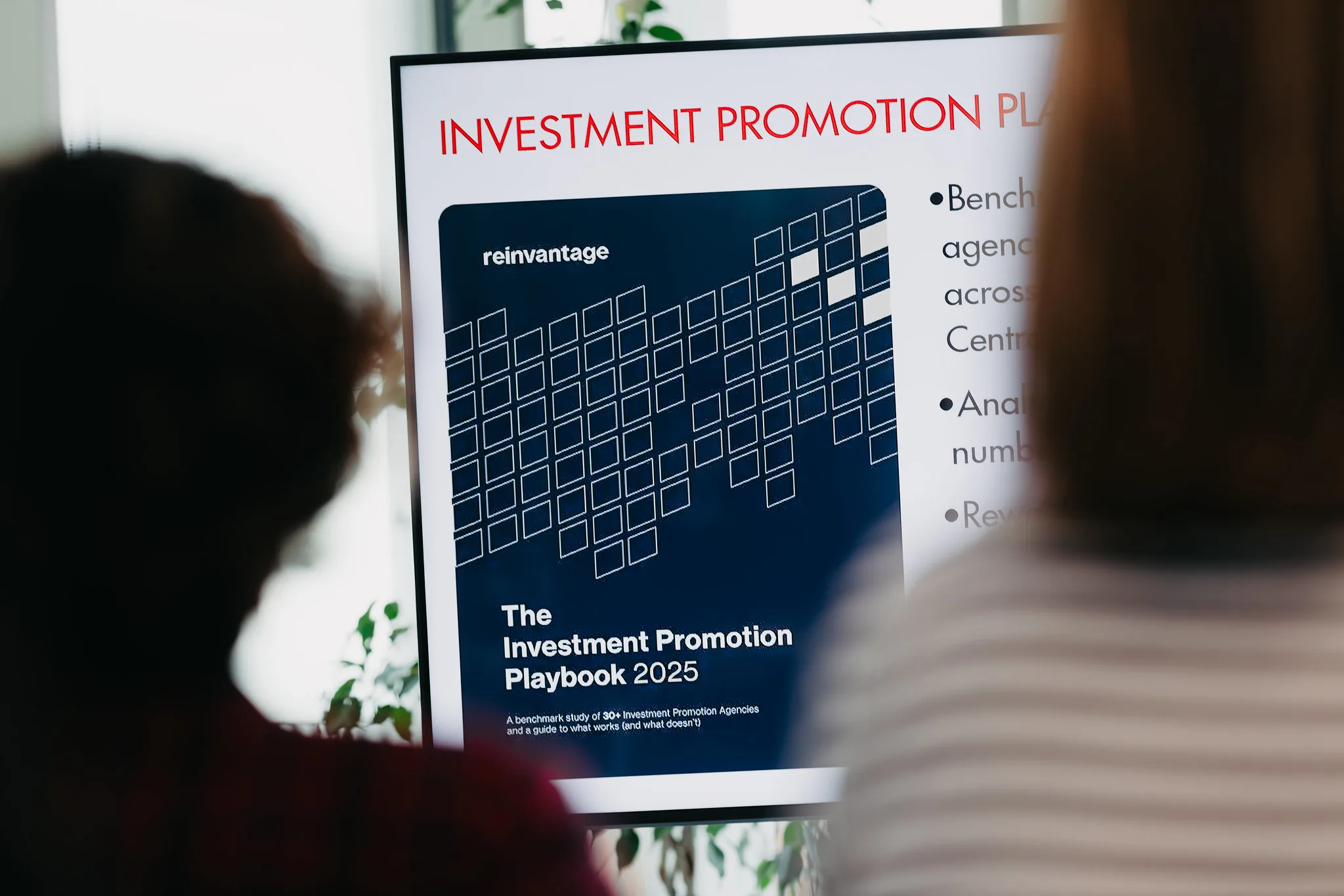
The Investment Promotion Playbook
The window of opportunity
But must reinvention always be sudden? Georgia’s experience after the 2003 Rose Revolution suggests the answer is emphatically yes, at least in the early stages. Kakha Bendukidze, the libertarian industrialist appointed as economy minister by Mikheil Saakashvili, was blunt about what needed to be done: “the window of opportunity provided by a revolution is short.”
He was not wrong. His team slashed the number of business licences by 90 per cent, fired and rebuilt the entire police force from scratch, cut taxes dramatically and dismantled Soviet-era bureaucracies wholesale. Georgia jumped from 137th to 11th in the World Bank’s ease of doing business rankings in four years. The Corruption Perceptions Index ranking went from 133rd in 2004 to 67th by 2008. Annual growth averaged 9.3 per cent between 2004 and 2007. That Georgia has in recent years regressed as a democracy is less about what it did post-Rose Revolution and more a demonstration of what happens when that political will for continual reinvention dissipates.
Rwanda took a different path to similarly striking results. Paul Kagame’s Vision 2020 strategy, laid out in 2000 and implemented through rolling four-year plans, opted for gradual but relentless reform, and the economy has grown at an average of roughly eight per cent annually since 1995. Kagame openly cites Lee Kuan Yew as an inspiration, and speaks of making Rwanda the Singapore of Africa. Whether he gets there or not, the ambition is serious and the institutional structures built, particularly the Rwanda Development Board, which consolidated business registration into a one-stop shop, is genuinely impressive. The key point is that however you carry out reinvention, the direction of travel cannot keep changing with the electoral weather.
Concrete goals, not abstract ideas
What, then, does successful reinvention actually require? The cases suggest at least four preconditions. A clear and specific vision of what the country wants to become. Not ‘innovation hub’ in the abstract, but Estonia’s Tiger Leap programme with its concrete targets for school connectivity, or Georgia’s decision to make itself the easiest place in the post-Soviet world to open a business (and for all its current faults, it probably still is). Political consensus broad enough to survive an election or two. A willingness to absorb short-term pain, whether the unemployment spike of Poland’s shock therapy or the decade-long patience of Rwanda’s gradualism. And, perhaps most critically, institutions designed to outlast the politicians who created them.
The Monocle blueprint for building a nation from scratch is a fine read. Reinventing one that already exists (with its vested interests, inherited pathologies, and selective memories) is considerably trickier. But it can be done.
Photo: Dreamstime.