



AI porn
Overexposed
The emperor’s new algorithm
parallax background

Protest in vain

CEE's protest season reveals the entrenchment of a post-democratic order

December 18, 2025

6 min read

December 18, 2025

6 min read

Photo: Dreamstime.

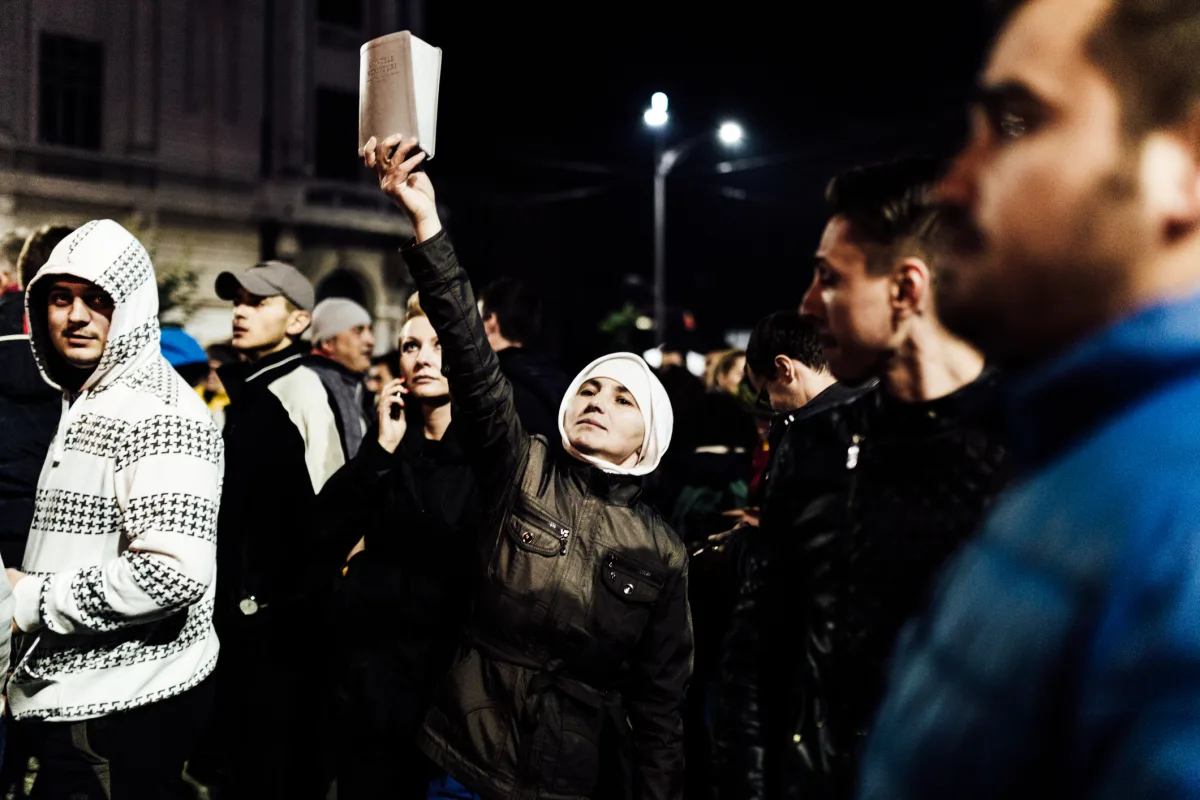
When Bulgaria’s government collapsed on December 11, just three weeks before the country is due to adopt the euro, protestors in Sofia projected the word ‘MAFIA’ onto the country’s parliament building. Two days later, tens of thousands marched through Budapest carrying torches to Viktor Orbán’s offices, demanding accountability for child abuse in state institutions. In Bucharest, demonstrators filled Piața Victoriei nightly after a documentary exposed systematic judicial corruption. All three followed Serbia’s student-led uprising, which has been paralysing cities since the deadly collapse of a train station roof in Novi Sad in 2024.

Across the region, the pattern is almost wearily familiar. Citizens discover—again—that their institutions serve oligarchs rather than the public. They take to the streets. Politicians make promises. And nothing fundamental changes. Bulgaria has held seven elections since 2021; an eighth is now likely. Romania has witnessed protests over judicial corruption for decades. Hungary’s opposition has been mobilising against Orbán since 2010. Serbia’s current wave is merely the latest in a series stretching back to 2018.

The conventional narrative frames these events as democratic resurgence—brave citizens challenging authoritarianism. But the repetition suggests something else: these countries have developed stable systems for neutralising dissent through ritualistic protest cycles that change nothing essential.

The oligarch’s toolkit

What unites Sofia, Bucharest, Budapest and Belgrade is not nascent democracy but a sophisticated machinery of state capture. Each protest emerged from a specific trigger, yet revealed identical underlying pathologies. Bulgaria’s demonstrations began over tax rises but focused on Delyan Peevski, the sanctioned oligarch whose party props up the government. Romania’s Recorder documentary showed how High Court President Lia Savonea allegedly orchestrates a pyramid to protect corrupt politicians from prosecution. Hungary’s child abuse scandal exposed state institutions serving Orbán’s patronage networks rather than vulnerable minors. Serbia’s protests revealed that President Aleksandar Vučić’s government awarded contracts to Chinese Belt and Road contractors without proper oversight, leading to 15 deaths.

Everywhere, the mechanics are nearly universal. Control the prosecutor’s office, ensuring high-level corruption cases disappear through procedural manipulation. Pack courts with loyalists who prolong trials until statutes of limitations expire. Use state-aligned media to deflect blame. Deploy counter-protestors when necessary. 

The genius of this system is its resilience. Elections provide the appearance of democratic choice without threatening power structures. Bulgaria’s corrupt elite simply rotate positions through different party labels; Transparency International ranks it amongst the EU’s most corrupt members alongside Hungary and Romania. Serbia dropped from 72nd to 105th on the Corruption Perceptions Index between 2013 and 2024 as Vučić consolidated control.

The protest paradox

The striking feature of these movements is how their very success at mobilisation confirms systemic failure. Romania’s documentary garnered nearly four million views within days. Over 170 magistrates publicly supported whistleblowers. Yet the Superior Council of Magistracy dismissed the allegations as a “well-planned strategy aimed at destroying trust in justice”. In Hungary, Péter Magyar’s Tisza party polls ahead of Orbán months before elections, yet few observers expect the electoral system to translate that support into power. Belgrade witnessed protests estimated at 200,000-300,000—larger than those that toppled Slobodan Milošević—but Vučić remains firmly entrenched.

The pattern indicates that street protests in captured states function less as democratic pressure and more as safety valves, allowing citizens to express outrage without threatening the fundamental architecture of power. Governments make tactical concessions—Serbia charged 13 people over the Novi Sad collapse, Bulgaria’s prime minister resigned—whilst preserving the corrupt systems that make disasters inevitable.

Even victory proves hollow. When Bulgaria’s government fell, political analysts predicted a new, eighth election would produce another fragmented parliament incapable of reform. The opposition leader called it “the first step in making Bulgaria a normal European state”, unconsciously acknowledging that no subsequent steps will follow. Romania’s President Nicușor Dan scheduled discussions for December 22—the anniversary of Nicolae Ceaușescu’s fall—a symbolic gesture that substitutes historical resonance for institutional change.

Brussels fiddles

The European Union bears considerable responsibility for this state of affairs. Having admitted Bulgaria and Romania in 2007 despite manifest rule-of-law deficiencies, Brussels deployed the Cooperation and Verification Mechanism (CVM) to monitor progress. It lifted the CVM for Romania just as judicial capture was reaching its apex. Hungary has received billions in EU funds whilst systematically dismantling checks and balances.

EU Commissioner for Enlargement Marta Kos recently stated that Serbia “cannot become a member of the European Union” without fighting corruption through independent institutions. But she immediately undercut this by adding that Vučić “is the only politician with whom we can currently discuss its European path.” This calculated realism—prioritising stability over standards—has enabled the very systems protestors now challenge.

The case of Serbia is particularly instructive. The EU signed a lithium deal with Vučić’s government in July 2024, securing resources for electric vehicle production. When protests erupted months later, Brussels remained largely silent, in stark contrast to its vocal support for demonstrators in Georgia. European trust in Serbia stands at just 37 per cent—the lowest among Western Balkan accession countries—yet the EU continues to treat authoritarian leaders as indispensable partners.

The democratic mirage

The ultimate irony is that these protests may accelerate rather than reverse democratic decline. Each cycle of mobilisation and disappointment deepens public cynicism. Most of Bulgaria’s seven recent elections came after protests secured resignations and reform promises, none of which materialised. Romanian activists have watched judicial corruption flourish despite decades of street demonstrations. Hungarian opposition unity fractured repeatedly after mass mobilisations failed to dislodge Orbán.

What emerges is not democracy but a post-democratic settlement: elections without accountability, protests without consequence, and institutions without independence. The Eastern Europe and Central Asia region averages 35 out of 100 on Transparency International’s Corruption Perceptions Index—well below the global average. Fifteen of nineteen countries have stagnated or declined as governments failed to implement basic anti-corruption measures.

The protest wave sweeping from Sofia to Belgrade signals not democratic awakening but the opposite: a regional settlement where capture is so complete that dissent can be safely tolerated, even encouraged, because it poses no genuine threat. Citizens march, politicians sometimes resign, and the oligarchs adjust their portfolios. Until the next corruption scandal provides another trigger for another protest cycle that changes nothing.

In this light, projecting ‘MAFIA’ onto Bulgaria’s parliament was less an act of resistance than a statement of fact—one the mafia itself can comfortably ignore.

Photo: Dreamstime.

Craig Turp-Balazs

Craig Turp-Balazs

Craig Turp-Balazs is head of insight and analysis at Reinvantage.

Share

Case study: Global technology company

1. The Client

A global technology company operating across EMEA, with a regional HQ in Istanbul. The company manages 20+ markets, handling everything from brand campaigns to strategic partnerships.

Role we worked with: The EMEA Head of Marketing (supported by two regional managers).

2. The Challenge

Despite strong products and a respected global brand, the regional team was struggling with:

  • Misaligned strategy across markets → campaigns executed with inconsistent narratives.
  • Slowed growth → lead generation plateaued despite increasing spend.
  • Internal friction → marketing, sales, and product teams disagreed on KPIs and priorities.

Traditional fixes (more meetings, more reporting) only created more noise.

3. The Sprint

We ran a 10-day Remote Reinvention Sprint with the regional HQ team.

  • Day 1–3: Intake → Reviewed decks, campaign data, and plans.
  • Day 4: Sprint Session (90 mins) → Breakthroughs:
    • Sales and marketing had different definitions of “qualified lead.”
    • 40% of spend was going into low-potential markets.
    • The team assumed the problem was lack of budget, but it was actually lack of alignment.
  • Day 5–10: Synthesis → Insights distilled into a Clarity Brief + Insight Canvas.
4. The Breakthrough

The Sprint uncovered that the issue wasn’t budget, but fragmentation.
Three sharp insights unlocked a way forward:

  1. Unified KPIs bridging marketing + sales.
  2. Market prioritisation → shifting budget to 5 high-potential markets.
  3. Simplified narrative → one EMEA core story, locally adaptable.
By just realigning resources and focus, the client could unlock an estimated £250,000 in efficiency gains within the next 12 months — far exceeding the Sprint’s value guarantee. The path to higher returns was already inside the business, hidden by misalignment.
5. From Sprint to Action (4 Pillars Applied)

With clarity secured, Reinvantage didn’t suggest “more projects.”

Instead, we used the Sprint findings to create laser-focused next steps — drawing only from the areas that would deliver the most impact:

  • Readiness → Alignment workshops for sales + marketing teams. New playbooks clarified “qualified lead” definitions and reduced internal disputes.
  • Foresight → A market-opportunity scan identified which 5 countries would deliver the highest ROI, removing the guesswork from allocation.
  • Growth → Guided the reallocation of €2M budget and designed a phased rollout strategy that protected risk while maximising return.
  • Positioning → Built a messaging framework balancing global consistency with local nuance, ensuring campaigns spoke with one clear voice.

Because the Sprint had stripped away noise, these actions weren’t generic consulting ideas — they were directly tied to the breakthroughs.

6. The Results
  • +28% increase in qualified leads across the region.
  • 30% faster campaign rollout due to streamlined approvals.
  • Budget efficiency gains → €2M redirected from low-return to high-potential markets.
  • Internal cohesion → marketing + sales now use a single shared dashboard.
The client came in believing they needed more budget.
The Sprint revealed that what they really needed was clarity and alignment.

With that clarity, the four pillars became not theory, but practical tools to deliver measurable impact.

The Sprint guaranteed at least £20,000 in value — but in this case, it helped unlock more than 10x that within six months.

Case study: Regional VC fund & accelerator

1. The Client

A regional venture capital fund and accelerator focused on early-stage tech start-ups in the Baltics and Central Europe.

The fund had raised a new round and was under pressure to deliver stronger returns while also building its reputation as the go-to platform for founders.

Role we worked with: Managing Partner, supported by the Head of Portfolio Development.

2. The Challenge

Despite a promising portfolio, results were uneven.

Key issues:

  • Scattered portfolio support → no consistent playbook for start-ups, every partner did things differently.
  • Weak differentiation → founders and co-investors saw the fund as “one of many” in the region.
  • Stretched team → too many small bets, not enough clarity on which companies to double down on.

The leadership team knew something was off, but disagreed on whether the issue was pipeline quality, market conditions, or internal capacity.

3. The Sprint

We ran a 10-day Remote Reinvention Sprint with the partners and portfolio team.

  • Day 1–3: Intake → Reviewed pitch decks, pipeline funnel data, and start-up performance reports.
  • Day 4: Sprint Session (90 mins) → Breakthroughs:
    • No shared definition of a “high-potential founder.”
    • Support resources were spread too thin across the portfolio.
    • The fund’s positioning was more reactive than proactive — it didn’t own a distinctive narrative in the market.
  • Day 5–10: Synthesis → Insights consolidated into a Clarity Brief + Insight Canvas.
4. The Breakthrough

The Sprint revealed that the challenge wasn’t pipeline quality — it was lack of focus and positioning.

Three core insights provided the turning point:

  1. Portfolio Prioritisation Framework → defined clear criteria for where to double down.
  2. Founder Success Playbook → standardised support model for portfolio companies.
  3. Differentiated Narrative → repositioned the fund as “the accelerator of reinvention-ready founders.”
These shifts alone gave the fund a path to add an estimated £2M+ in portfolio value over the following 18 months, by concentrating capital and resources where they could move the needle most.
5. From Sprint to Action (4 Pillars Applied)

With clarity from the Sprint, Reinvantage created a tailored support plan:

  • Readiness → Coached partners on using the new prioritisation framework and trained the team on deploying the Founder Success Playbook.
  • Foresight → Ran scenario analysis on regional tech trends, helping the fund anticipate where capital would flow next.
  • Growth → Guided resource reallocation across the portfolio and supported new co-investor pitches for top-performing start-ups.
  • Positioning → Crafted a sharper brand story for the fund, positioning it as the reinvention partner for globally minded founders.
6. The Results
  • 10 portfolio companies onboarded to the new Playbook → greater consistency of support.
  • Raised follow-on capital for 3 top start-ups with the new prioritisation framework.
  • +26% increase in inbound deal flow from founders citing the fund’s new positioning.
  • Stronger internal cohesion → partners aligned on where to focus resources.
The client thought the problem was pipeline quality.
The Sprint showed it was actually lack of clarity and focus inside the firm.

By applying the four pillars, Reinvantage helped turn scattered effort into concentrated value creation.

The Sprint guaranteed at least £20,000 in value; here it set the stage for multi-million-pound upside in portfolio growth.

Case study: International impact Organisation

1. The Client

A large international impact organisation focused on entrepreneurship and economic empowerment.
The organisation runs multi-country programmes across Eastern Europe and Central Asia, often in partnership with global donors and corporate sponsors.

Role we worked with: Senior Programme Director, responsible for regional coordination.

2. The Challenge

The organisation had launched a flagship regional initiative supporting women entrepreneurs, but the programme was underperforming.

Key issues:

  • Fragmented delivery → each country office interpreted the programme differently.
  • Donor frustration → reporting lacked consistency and clear impact metrics.
  • Lost momentum → staff energy was spent on administration rather than scaling success stories.

Traditional programme reviews had produced long reports, but no real alignment or action.

3. The Sprint

We ran a 10-day Remote Reinvention Sprint with the regional leadership team and representatives from two country offices.

  • Day 1–3: Intake → Reviewed donor reports, programme KPIs, and field feedback.
  • Day 4: Sprint Session (90 mins) → Breakthroughs:
    • Donors cared about quantifiable outcomes, but reporting focused on stories.
    • Staff were duplicating efforts across countries, wasting time and resources.
    • The initiative lacked a clear theory of change — everyone described its purpose differently.
  • Day 5–10: Synthesis → Insights distilled into a Clarity Brief + Insight Canvas.
4. The Breakthrough

The Sprint revealed that the issue wasn’t donor pressure or programme design — it was a lack of shared framework and alignment.

Three critical insights reshaped the path forward:

  1. One Unified Theory of Change → agreed narrative for why the programme exists.
  2. Core Impact Metrics → clear, comparable KPIs across all countries.
  3. Smart Resource Sharing → digital hub to stop duplication and accelerate knowledge flow.
By eliminating duplicated reporting and clarifying what success looks like, the client saw they could save the equivalent of £100,000 in staff time annually — while also unlocking stronger donor confidence and follow-on funding opportunities.
5. From Sprint to Action (4 Pillars Applied)

Armed with Sprint clarity, Reinvantage proposed a laser-focused support plan:

  • Readiness → Trained programme leads on using the new metrics and integrated them into existing workflows.
  • Foresight → Analysed donor trends and expectations, aligning the initiative with the next funding cycle.
  • Growth → Developed a funding case based on the new unified theory of change, securing higher renewal chances.
  • Positioning → Crafted a regional success narrative and storytelling toolkit, helping them showcase results consistently across markets.
6. The Results
  • 30% less time spent on reporting → freed capacity for programme delivery.
  • Donor satisfaction improved → positive feedback on the clarity of impact evidence.
  • Secured new funding commitment → one major donor increased their contribution by 20%.
  • Stronger internal morale → staff felt they were working with clarity, not chaos.
The client thought it needed better donor management.
The Sprint revealed it needed a shared foundation across its teams.

By anchoring on the four pillars, Reinvantage turned alignment into efficiency gains and fresh funding opportunities.

The Sprint guaranteed at least £20,000 in value; here it unlocked both six-figure savings and future-proofed funding.

Case study: National digital development agency

1. The Client

A national digital development agency tasked with driving the government’s digital transformation agenda, including e-services, citizen portals, and smart city pilots.

Role we worked with: Director of Digital Transformation, supported by IT and service delivery leads from three ministries.

2. The Challenge

The agency had strong political backing but faced hurdles in implementation.

Key issues:

  • Siloed projects → each ministry developed digital tools independently, leading to duplication.
  • Citizen frustration → services were digital in name, but still required multiple logins and offline steps.
  • Funding pressure → international partners demanded clearer impact in the short term.

The agency wanted to accelerate momentum but struggled to get alignment across ministries.

3. The Sprint

We ran a 14-day Immersive Reinvention Sprint with the agency’s leadership and digital focal points from three ministries.

  • Day 1–3: Intake → Reviewed strategy docs, donor reports, and citizen feedback data.
  • Day 4: Immersive Sprint Session (half-day) → Breakthroughs:
    • Each ministry had different definitions of “digital service.”
    • 20% of budget was going into overlapping pilot projects.
    • Citizens’ top frustrations were known — but not prioritised.
  • Day 5–14: Synthesis → Insights consolidated into a Clarity Brief + Insight Canvas.
4. The Breakthrough

The Sprint revealed that the biggest blocker wasn’t lack of funding, but lack of shared priorities.

Three practical insights stood out:

  1. One Definition of Digital Service → agreed across ministries.
  2. Quick-Win Prioritisation → focus on top 3 citizen pain points (ID renewal, business registration, healthcare booking).
  3. Shared Resource Map → pool budgets to eliminate duplication.
These changes alone allowed the agency to unlock £75,000 in immediate savings and deliver 2–3 visible improvements in the next quarter — meeting donor expectations and building citizen trust.
5. From Sprint to Action (4 Pillars Applied)

Based on the Sprint clarity, Reinvantage proposed a modest, targeted package of support:

  • Readiness → Facilitated inter-ministerial workshops to embed the “one digital service” definition.
  • Foresight → Analysed citizen feedback trends to shape the quick-win roadmap.
  • Growth → Supported the reallocation of funds to joint projects, reducing overlap.
  • Positioning → Crafted a communication plan highlighting early digital wins to donors and citizens.
6. The Results
  • 2 pilot services integrated into the central portal (ID renewal + healthcare booking).
  • Budget savings of £75,000 from eliminating overlapping projects.
  • Citizen satisfaction up modestly → call centre complaints on digital services dropped by 12%.
  • Donor confidence improved → short-term impact report received positive feedback.
The client thought it needed more funding and bigger projects.
The Sprint revealed it first needed clarity and alignment.

By applying the four pillars to a targeted scope, Reinvantage helped deliver visible results within a single quarter — proving progress to citizens and donors and laying the groundwork for deeper transformation.

You must be logged in to view this page. Login here.

Bridging the Reinvention Gap: Fill this form and get your preview copy immediately.

Future of IT: Fill this form and get your preview copy immediately.

War for Talent: Fill this form and get your copy immediately.

The Voice of Ukrainian Start-ups: Fill this form and get your copy immediately.

The uncounted engine: Ukraine’s start-up rise. Fill this form and get your copy immediately.

The Investment Promotion Playbook 2025: Fill this form and get your preview copy immediately.

The Reinvention Masterclass for Start-up Founders: Join the private cohort

Beyond Borders: Join the private edition