
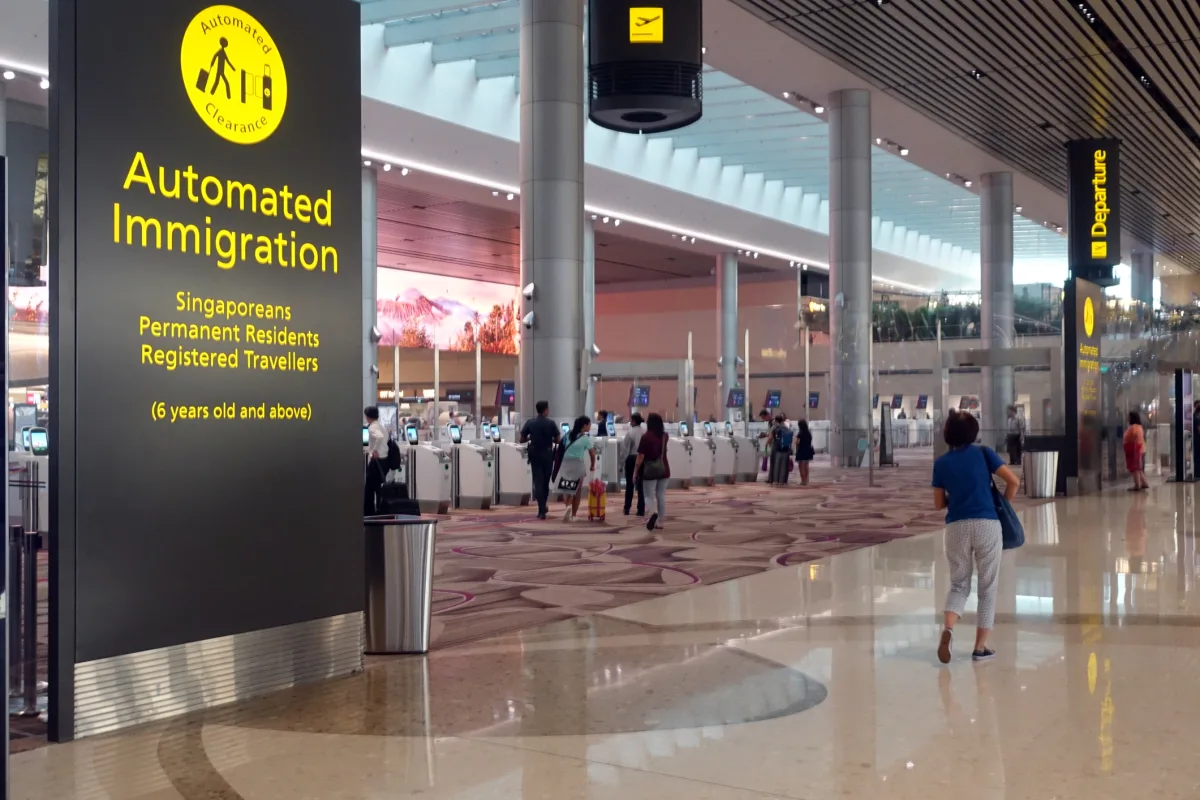
Singapore’s Changi Airport is one of the world’s busiest. It sees more annual traffic than Frankfurt, Schiphol in Amsterdam, and JFK in New York. Add in Singapore’s strict rules on who can enter the country (and for how long), and you have, potentially at least, all you need for chaos to ensue.
Queues at immigration, however, are unheard of at Changi. The process of checking passports and taking biometrics (facial scans and fingerprints) is fully automated and completed in seconds. Obligatory pre-registration on a smartphone app means that the Singaporean authorities already know who’s coming, where they will stay, and how long they will stay. As with much about Singapore, it’s a lesson in efficiency and best practice.
Authorities in Europe would have done well to study Singapore’s methods before finally (after long delays) rolling out its Entry and Exit System (EES) last year. The system has been introduced in stages since then, and will become fully operational on April 10. From then, every non-EU citizen (with some exceptions, such as long-term residents) entering the Schengen area will have their biometrics recorded and stored for a period of three years.
The system is already causing headaches for passengers and border staff. At some airports, notably Brussels, Geneva, Krakow, Lisbon, Prague and Tenerife South, queues at passport control have at times run to many hours. The problem is particularly acute for departing or transfer passengers, who risk missing flights. Associations representing airports, airlines, and travel agencies have all called for EES to be suspended over the summer. Ryanair’s Michael O’Leary, never a man for understatement, called the system “a shambles”.
Brussels, we have a problem
Critics of the EES do not dispute its goal of strengthening Europe’s border security, merely stressing that implementation must remain operationally viable to ensure smooth airport operations, especially during busy travel periods.
But according to ACI Europe, an airports trade body, processing times have risen by 70 per cent at some locations since the rollout began in October. At Brussels Airport, 600 passengers missed flights over just four days in late March. Portugal pulled the plug on the system at Lisbon Airport in December after widespread chaos, stationing officers from the National Republican Guard at checkpoints to restore a semblance of order. Spain’s Gran Canaria Airport saw border gates crash repeatedly over the Christmas period, forcing staff to fall back on the quaintly analogue method of stamping passports by hand.
Things will likely get worse before they get better. ACI Europe, Airlines for Europe, and the International Air Transport Association (IATA) wrote jointly to the European Commission in February warning that summer queues could reach four hours. Traffic at Europe’s airports roughly doubles between June and August. The Commission has repeatedly insisted that the system is “on track” and has pointed to more than 30 million entries and exits registered so far. It has also allowed member states to partially suspend EES checks for up to 90 days after full deployment, a flexibility that somewhat undermines the claim that everything is going well.
Contrast all of this with Changi. Singapore’s Immigration and Checkpoints Authority fully rolled out passport-free clearance across all four of its terminals in September 2024. Average processing time dropped from 25 seconds to ten. The system uses facial recognition, iris scanning, and fingerprints, and 95 per cent of travellers clear immigration through automated lanes. Officers freed from checking documents are redeployed to interviewing and profiling, a better use of human judgment. The technology was first piloted at Terminal 4 in 2017 and refined for nearly a decade before going system-wide. In Brussels, by comparison, 36 e-gates ordered for biometric enrolment had still not arrived as of late March.
Not invented here
The gap between the two approaches points to a deeper problem with how governments (and supranational bodies like the EU) tackle big technology projects. The EES was first proposed in 2016. Its original go-live date was 2022. It was postponed to May 2023, then late 2023, then November 2024, before finally limping into a phased start last October. A decade of development and the EU still cannot get passengers through a booth without crashing the software.
Part of the trouble is structural. Coordinating border technology across 29 countries, each with its own legacy infrastructure, staffing levels and procurement habits, is fiendishly complex. Singapore, a city-state of six million people, controls a handful of entry points. The Schengen area has hundreds.
But scale does not explain why the EU chose to build so much from scratch. Singapore’s biometric clearance technology, supplied by IDEMIA, a French firm no less, is commercially available. So are the pre-registration platforms and automated lane systems that make it work. Governments and their sprawling procurement machines have a stubborn habit of treating each project as bespoke, commissioning vast custom systems when perfectly good off-the-shelf alternatives exist. The affliction is sometimes called ‘not-invented-here syndrome’, and it is epidemic in public-sector IT.
Bespoke projects mean bigger contracts, longer timelines, and more billable hours for consultancies and systems integrators. Procurement rules in the EU, designed to ensure fairness and competition, often shut out proven solutions in favour of elaborate, purpose-built white elephants. By the time these are delivered (late, over budget, and full of bugs), the technology they were supposed to leapfrog has moved on.
The lesson from Singapore is not that small is easy and big is hard. It is that good technology starts with ruthless pragmatism: study what works elsewhere, buy what you can, build only what you must, test relentlessly before going live. Europe’s approach to the EES has been the opposite. Travellers stuck in four-hour queues this summer will have plenty of time to reflect on the difference.
Photo: Dreamstime.