
Estonia has a population of 1.4 million. By the metrics that Silicon Valley uses to measure itself, that is smaller than most of its portfolio companies. And yet Estonia is home to ten unicorn companies (start-ups valued at over one billion US dollars), a density of 7.3 per million inhabitants that no country on earth can match. Wise, the payments platform, is worth 13 billion US dollars. Bolt, the ridesharing company, emerged from the same ferment that produced Skype, which in turn bankrolled many of the founders who built both. The virtuous cycle is real, and it has made a country the size of a mid-sized American city into one of the world’s most productive start-up launchpads.
The catch, as a new report from the Vienna Institute for International Economic Studies (wiiw) makes plain, is that while high-density hubs such as Estonia (as well as Lithuania and Croatia) prove that innovation can spark anywhere, the path to becoming a global giant often still leads westward, even as the R&D roots remain firmly planted in the region.
Between 2008 and 2021, nearly 30 per cent of European unicorns relocated their headquarters abroad. The pattern holds across Central, East and Southeast Europe (CESEE): the region builds companies that the rest of the world claims. It is, in the language of development economics, a brain drain with particularly good branding.
The wiiw analysis, which draws on Eurostat’s Structural Business Statistics and patent data from the OECD, maps the sectoral structure of small firms across the region — companies with between ten and 49 employees that are, by and large, mature start-ups approaching the inflection point where growth requires either deep capital or relocation. What it reveals is extraordinary patchwork: a handful of urban clusters generating almost all of the region’s innovation value, the territory surrounding them barely registering.
Prague accounts for more than 80 per cent of Czechia’s total start-up enterprise value. Vilnius dominates Lithuania’s innovation landscape to a comparable degree. Warsaw, for all Poland’s scale (the country hosts 14 unicorns, the most in the region) ranked only 91st in StartupBlink’s global city index for 2025, a measure of ecosystem vitality rather than sheer bulk. Poland’s strength lies in its breadth, not its peaks.
Sector by sector
The sector of the moment is digital. According to Eurostat, CESEE’s digital economy sector grew at an average annual rate of 5.6 per cent between 2021 and 2024, outpacing every other sector in both the short and medium term. Croatia, home to Infobip, the cloud-communications unicorn, has been among the fastest-growing digital markets in the region. Serbia’s figures (partly a statistical artefact of a very low base) show a short-term growth rate in digital economy small firms of 475.7 per cent, which is either spectacular or terrifying depending on where you sit.
Production, by contrast, is in trouble. Export-oriented manufacturing across CESEE contracted 1.5 per cent in the year to 2024 and has been shrinking at 2.5 per cent annually since 2021. The wiiw analysts point to the US trade war as a proximate cause, though the structural problems (ageing workforces, wage pressures, rising energy costs) were building long before tariffs entered the equation.
Life sciences tells a more nuanced story. The sector is small, just 10,116 small firms across the region, accounting for 3.3 per cent of the total, but the patent data reveals something the firm counts obscure. Lithuania, despite generating modest patent volumes in absolute terms, directs more than 10 per cent of its total patent activity towards biotechnology. Estonia leads CESEE in AI-related patents as a share of its overall portfolio.
The dual-hub model
The uncomfortable question hanging over this is what do you do with a region that is brilliant at starting things and poor at scaling them?
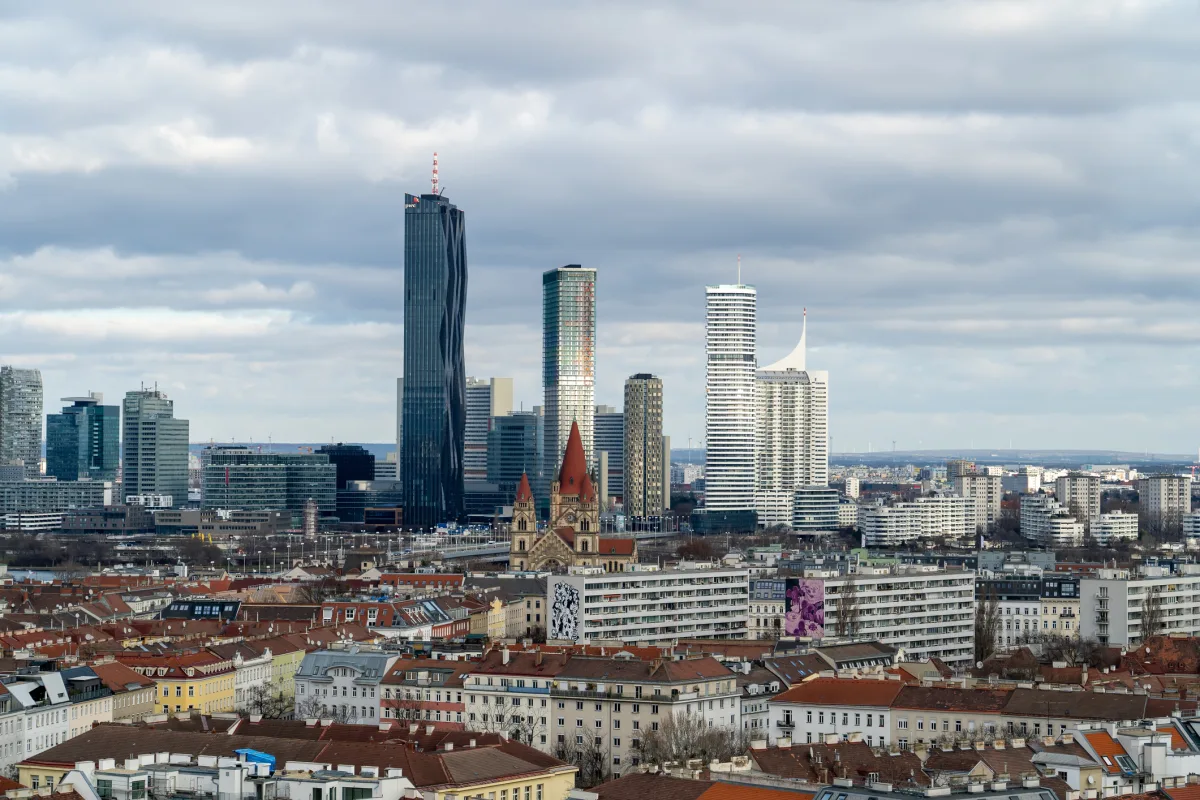
The answer the wiiw report proposes is Vienna. The Austrian capital ranked 74th in the StartupBlink global ecosystem index for 2025, up nine places from the previous year, with ecosystem growth of 27.1 per cent. It sits inside the World Intellectual Property Organization’s top 100 innovation clusters. It has research universities, financial infrastructure, and (the selling point the report leans on most) geographic and cultural proximity to the rest of CESEE. A Croatian deep-tech firm seeking Western European capital has a shorter journey, logistically and culturally, to Vienna than to London.
The dual-hub model the wiiw researchers advocate is not new. Silicon Valley has practised it for decades: engineering teams in Warsaw or Bangalore, headquarters in Palo Alto. What is new is the suggestion that this arbitrage can work within the EU, and that keeping value inside the bloc is worth engineering deliberately. A halfway house, in other words, rather than emigration.
Whether Vienna can carry that weight is another matter. The deeper problem the wiiw report documents, such as fragmented capital markets, absent late-stage venture funding, no pan-European equivalent of Nasdaq, will not be resolved by encouraging a few hundred start-ups to open satellite offices in the first district. Mario Draghi’s preferred remedy, the Capital Markets Union, remains more ambition than architecture.
Lithuania offers a more instructive glimpse of what regional success can look like. Its Vilnius-centred ecosystem has been the fastest-growing in CESEE since 2020, nearly sextupling in value and producing winners in cybersecurity and digital marketplaces, most notably Nord Security. Poland has built a formidable creative economy on gaming (CD Projekt, Techland, Huuuge Games) and ElevenLabs, a Polish-founded AI voice company now headquartered in London, reached a 6.6 billion US dollars valuation this year. The region can produce world-class companies.
Nevertheless, as wiiw concludes, in the absence of fully realised Capital Markets Union reforms, regional innovation corridors may represent the most immediately actionable mechanism to address Europe’s scaling challenge.
Designing these corridors intentionally could transform CESEE’s concentrated innovation strength into sustained, EU-wide competitiveness.
Photo: Dreamstime.