
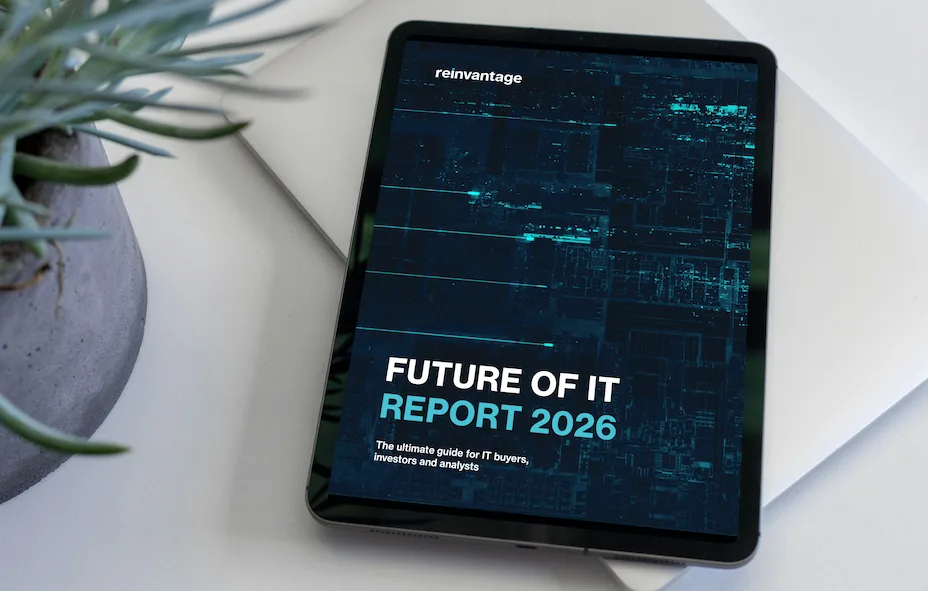
Future of IT Report 2026
Which countries will own the digital economy — and which will be priced out of it?
The global IT race has changed. Talent alone no longer wins. Cheap labour is no longer a strategy. And building “an IT sector” without coherence now leaks value instead of compounding it. The Future of IT Report 2026 is an independent data-driven guide for governments, investors, and institutional decision-makers who need to understand where digital advantage is actually being created — and why.
Many readers use the report as a shared reference point before deeper strategic work.
Original analysis • 32 markets • CEE • SEE • Caucasus • Central Asia
Instant access • 108-page PDF
The Old IT Playbook Is Breaking
For two decades, many countries followed the same formula: train more developers, compete on cost, build hubs, accelerators, and incentives. It worked — until it didn’t.
- Automation is eliminating junior roles
- AI is compressing value chains
- Offshoring is erasing wage arbitrage
- Productivity gains are flattening even as headcount rises
Capability without coherence does not compound. It leaks.
What the Future of IT Report 2026 Is
The Future of IT Report 2026 is an independent market intelligence report that analyses IT competitiveness across 32 countries in Europe, the Balkans, the Caucasus, and Central Asia.
It is used by policymakers, senior IT executives, investors, and advisors to understand where digital advantage is compounding — and where it is eroding — in the AI era.
Albania • Armenia • Azerbaijan • Belarus • Bosnia & Herzegovina • Bulgaria • Croatia • Cyprus • Czechia • Egypt • Estonia • Georgia • Greece • Hungary • Jordan • Kazakhstan • Kosovo • Kyrgyzstan • Latvia • Lithuania • Moldova • Mongolia • Montenegro • North Macedonia • Poland • Romania • Serbia • Slovakia • Slovenia • Tajikistan • Türkiye • Ukraine • Uzbekistan
What Truly Creates IT Competitiveness Now
The Future of IT Report 2026 shows that digital advantage today emerges from systems, not scale.
Winning countries align five elements into a single compounding engine:

Talent
Not just volume, but relevance and progression.

Infrastructure
Digital, institutional, and operational foundations.

Economic Impact
Value added, exports, and resilience — not vanity headcounts.

Business Environment
Trust, predictability, and intellectual property protections.

Future Technologies
AI readiness, governance, and real-world deployment that scales.
Break any link in this chain, and the flywheel stalls.
"The Future of IT Report was a valuable and widely referenced resource in our Private Sector Opportunities for a Green and Resilient Reconstruction in Ukraine publication."
Natsuko Toba, IFC (World Bank Group)
The IT Competitiveness Index 2026
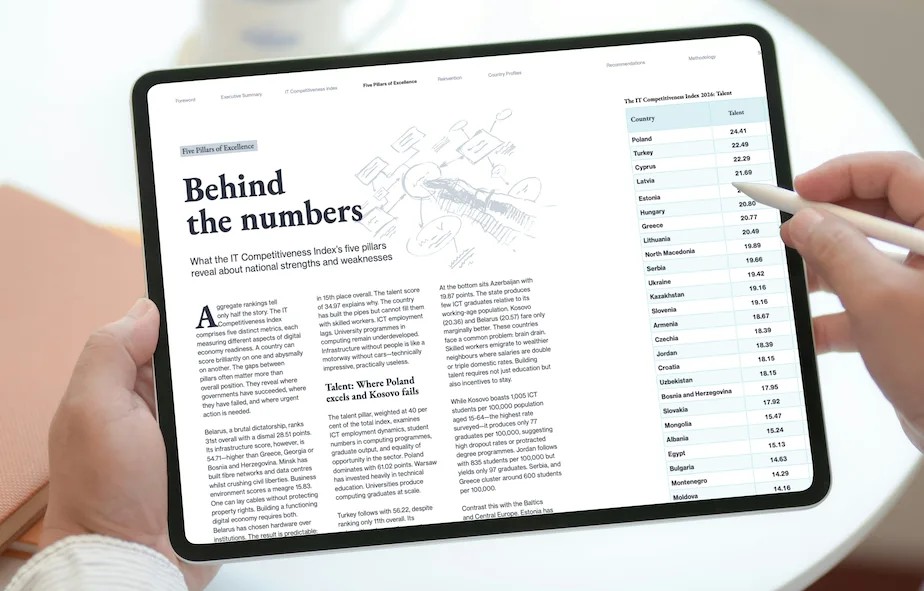
At the heart of the report is the Reinvantage IT Competitiveness Index, now expanded to 32 countries.
The index includes 49 metrics to show why some ecosystems compound advantage while others quietly stall.
You’ll see clearly which countries are compounding advantage, which are stagnating, and discover who is sliding into irrelevance.
No vanity rankings. No hype. Just hard trade-offs made visible.
Country Playbooks, Not Just Scores
Numbers alone don’t change outcomes. Decisions do.
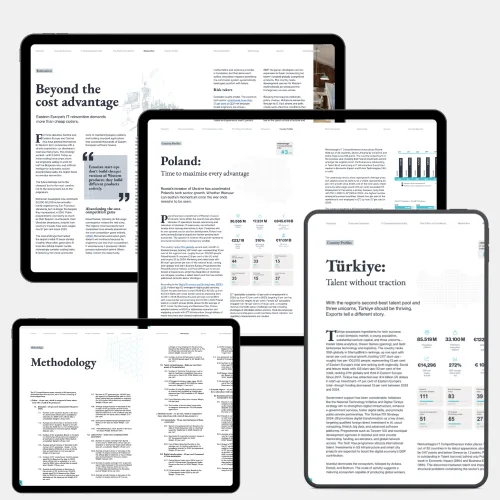
That’s why the report includes 32 country-level analysis and playbooks:
What top performers did differently, where underperformers went wrong – and which levers still matter (and which no longer do).
Estonia
How digital government became the foundation for compounding innovation.
Poland
How focusing on a winnable niche (gaming) turned policy into export impact.
Moldova
How tax simplicity and reduced friction accelerated ecosystem formation.
Romania
How policy reversals can reset trust and stall momentum.

Referenced by Decision-Makers Across Government and Industry
The Future of IT Report is not crafted for publicity. It is designed to be used.
Previous editions have been referenced publicly by government bodies, development institutions, and policy organisations, and used internally by senior leadership teams at IT and digital services companies operating across the region.
Readers include:
- National and regional public-sector institutions
- Multilateral and development organisations
- Senior management teams at leading IT and digital services firms

In many cases, the report serves as a shared factual baseline for strategy discussions — aligning public and private stakeholders around the same data, trade-offs, and constraints.
Who This Report Is For
This report is written for people who run, shape, and allocate within IT systems — not just those who regulate them.
You’ll get the most value if you are:
- A senior leader at an IT or digital services company operating in Europe, the Balkans, the Caucasus, or Central Asia
- A CEO, COO, CTO, or strategy lead deciding where to invest, hire, expand, or exit
- A policymaker or public-sector leader shaping national or regional digital strategy
- An investor, fund, or development institution allocating long-term capital
- An analyst, advisor, or ecosystem builder working at country or multi-country level
This is not for:
- Readers looking for generic tech trends or vendor forecasts
- Startup tactics or growth hacks
- Optimistic narratives without accountability
What you will walk away with
After reading the Future of IT Report 2026, you will have:
- A clear mental model for IT competitiveness in the AI era
- Evidence-backed comparisons across 32 countries
- Insight into where compounding advantage actually comes from
- A sharper sense of which markets still make sense — and which don’t
Many readers use the report as a shared reference point for policy discussions, investment theses, and strategic alignment.
WHY THIS RESEARCH IS TRUSTED
You’re not buying “Reinvantage services” on this page — you’re buying decision-grade market intelligence.
This section exists to answer the quiet question senior buyers always ask:
“Why should I trust this source over the dozens of glossy reports competing for attention?”
40,000+ READERS
The Future of IT Report is now in its 5th edition, covering 32 markets and read by over 40,000 IT leaders, buyers, policymakers, and advisors worldwide.

INSTITUTIONAL DELIVERY
Reinvantage has been advising governments and IT companies for over a decade.
Our Beyond Borders framework is delivered to IT companies through GIZ programmes in 6 countries and to Visa’s She’s Next programme across 17 markets.

ECOSYSTEM LEADERSHIP
Reinvantage leads Tech Eurasia Advocates, part of the Global Tech Advocates network. We have convened 3,000+ IT and tech leaders across events in the UK, Germany, Sweden, Denmark, and Poland.
"I first used the Future of IT Report in 2022 to help me make a case to expand operations in Romania in my previous role. The insight is high quality and applicable."
Vadim Echim
£49 · 108 pages • Instant digital access (PDF)
Secure Stripe checkout • 7-Day money-back guarantee
Get the Future of IT Report 2026
Decision-grade market intelligence. Instant access.
What this report helps you decide:
• Which countries or markets are falling behind – and which present the most opportunities
• Which IT investment narratives are noise vs signal
• What to prioritise in the next 12–24 months
Looking to apply these insights to your country, company, portfolio, or institution? Many readers follow up with a strategic sprint or advisory engagement.