

Who didn’t love their BlackBerry? Email in your pocket, free instant messaging, and a keyboard that felt so good you ended up typing far more than you usually intended. In my days as a travel writer, long afternoons would be spent in cafes typing out notes (and often, full articles) on this amazing device. Rarely did I feel the need to travel with a laptop: the BlackBerry did everything I needed, right up to the point when it didn’t.
Arguably, it wasn’t the launch of the first iPhone, in 2007, that killed the BlackBerry, but the launch, a year later, of the AppStore. Always built with busy business people (or travel writers) first and foremost in its thinking, BlackBerry completely missed the app-driven innovation that the iPhone (and its competitors) brought about. Most non-native apps both looked bad and performed poorly on BlackBerry phones. Just about everything outside of its core functions of email and messaging, from playing music to playing games, required often awkward workarounds. Apps were built for touchscreens (and the iOS and Android operating systems they used) from the start, and by the time BlackBerry embraced the touchscreen (and launched its own version of the AppStore) it was too late. Developers were reluctant to produce apps for a third operating system, and few did. Innovation had made BlackBerry’s biggest selling point, that beautiful keyboard, irrelevant.
At its peak, BlackBerry accounted for over 50 per cent of the US and 20 per cent of the global smartphone market, and sold over 50 million devices each year. You’d be hard pressed to find anyone still using a BlackBerry today, anywhere in the world. The firm officially stopped manufacturing its own devices in 2016 and ceased all support for its operating systems in 2022. A few BlackBerry devices running Android might still be in use, mainly by nostalgics.
The keyboard strikes back
For many former Blackberry users, however, the feel of that physical keyboard has always been seductive. Now, London-based firm Clicks Technology is hoping that there are enough of us to make its new Clicks Communicator a viable reinvention of the once ubiquitous device.
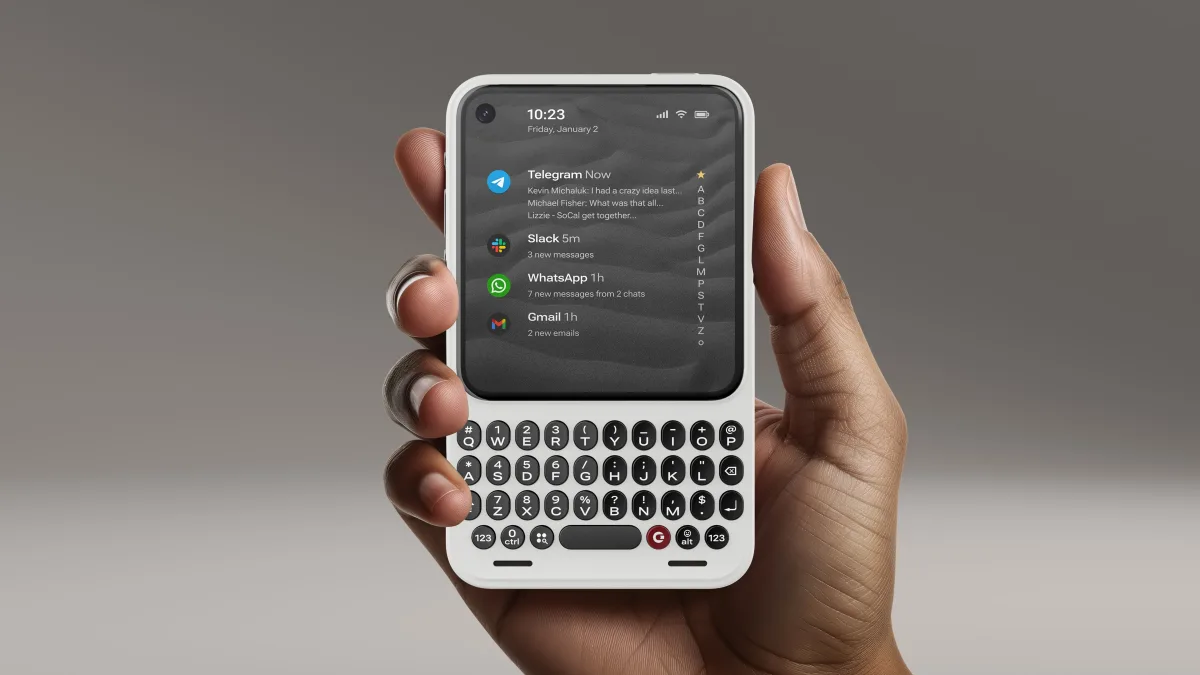
Clicks has for several years been making keyboard cases that add a physical keyboard to iPhones and Google Pixels. The Clicks Communicator is a stand-alone device, running on Android. It is, in almost every way, a BlackBerry in all but name. The device packs a 4.03-inch AMOLED display, runs Android 16, and is powered by a MediaTek 4-nanometre processor, making it modern enough for the most demanding user. Its standout feature is a touch-sensitive physical keyboard that doubles as a scroll pad, letting you navigate messages and web pages without lifting a finger to the screen. Old-school touches abound: a 3.5mm headphone jack, a physical SIM card tray, and a microSD card slot supporting up to 2TB of storage. A mute switch. A notification light. If this sounds like 2008, that’s quite deliberate.
What Clicks is explicitly not selling is distraction. The Communicator’s homescreen, built with minimalist launcher Niagara, prioritises messaging and productivity tools like Gmail, WhatsApp, Slack, and Telegram, with no icon drawer to drag you down a rabbit hole. You can still install anything from the Play Store of course, as fun is merely deprioritised, not forbidden. A customisable indicator light on the side of the device glows in different colours to signal the arrival of messages, so you know whether that buzz was worth picking the phone up. The whole experience is engineered to make you feel, if not productive, at least intentional.
The reception at consumer tech extravaganza CES 2026 was good. Early-bird customers who place a 199 US dollars deposit can reserve the phone (which could begin shipping as early as this month) for 399 US dollars. The full retail price is 499 US dollars. For a second phone (which is how Clicks explicitly positions it) that is a serious ask. Plenty of perfectly capable Android handsets cost less.
Beyond nostalgia
The Communicator’s real pitch, though, has less to do with keyboard tactility than with a deeper cultural shift. On average, people spend four hours and 37 minutes on their phones each day. (The average American spends five hours and 16 minutes). The Communicator sits in a growing category of devices (alongside the Light Phone and Punkt) punting on the idea that productivity and focus, rather than content consumption, matter to enough people to make their devices viable. Unlike those stripped-back devices, however, the Communicator doesn’t ask you to give up the full Android ecosystem. That compromise might be precisely what gives it traction.
There is a broader lesson here for other companies watching dead products with sentimental followings. BlackBerry itself, or rather the software firm that inherited the brand, missed the moment entirely, having licensed the name to a series of mediocre Android devices before giving up on hardware altogether. Clicks might succeed where it failed because it appears to understand what people actually missed. It wasn’t the BlackBerry operating system, the BBM network, or even the form factor per se. It was the feeling that the phone was a tool for getting things done, not a portal to infinite distraction.
Whether the Communicator can convert enough people beyond the nostalgics to justify the business is another matter. Clicks will need to demonstrate it has tapped a structural shift in how people want to use their phones, and not merely harvested a wave of nostalgia and early-adopter sentiment. If screen time really has become the tobacco of the digital age, a phone designed to help you doomscroll a bit less might, counterintuitively, be one of the smarter bets in recent consumer electronics. For those of us who spent long afternoons typing in cafes on our BlackBerrys, it would be pleasing if the device that helped kill it turned out, in the end, to vindicate it.
Photo: Clicks Technology.