


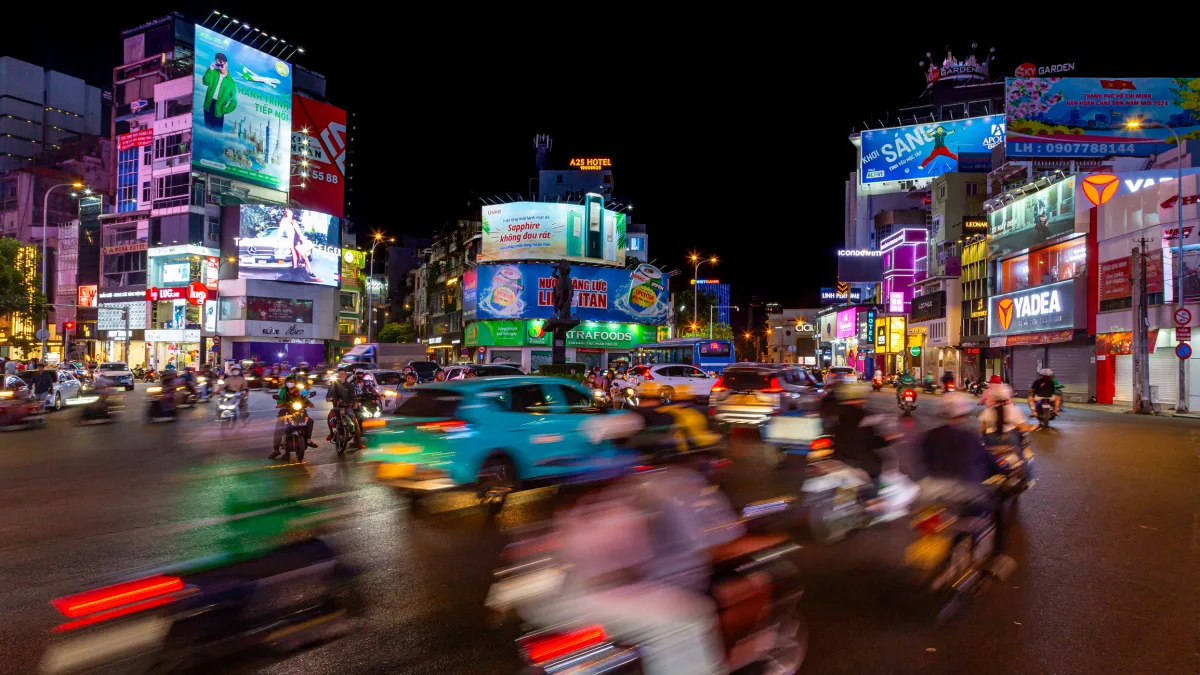
In an era of permacrisis, where supply chain fragmentation meets geopolitical volatility and economic nationalism, Asia isn’t waiting for consensus. It’s competing forward.
Three hubs prove this better than most: Ho Chi Minh City, Johor, and Hainan. Each is reinventing itself not through marketing campaigns, but through structural repositioning—recalibrating how they connect to global capital, talent, and trade flows. Together, they reveal a fundamental truth: intra-Asian competition isn’t a liability. It’s the engine of the Asian century.
These aren’t cookie-cutter models. They’re distinct experiments shaped by national strategy and regional ambition. But what unites them is timing. This year is the inflection point: for Ho Chi Minh City’s International Financial Centre, for the Johor–Singapore Special Economic Zone, and for Hainan’s evolution as China’s most open global interface.
The question for global investors isn’t whether Asia matters—it’s whether they can read the competitive map fast enough to stay relevant.
Ho Chi Minh City: From factory floor to financial bridge
Ho Chi Minh City has long been Vietnam’s economic engine—a manufacturing magnet, technology hub, and consumer growth powerhouse. What changes the equation now is the ambition to move decisively up the value chain.
The Ho Chi Minh City International Financial Centre, expected to gain momentum from 2026, isn’t about challenging Singapore or Hong Kong head-on. That would be strategic folly. Its real power lies in positioning itself as the financial connector for a high-growth, reform-driven economy.
Vietnam’s advantages are well established: political stability paired with pragmatic reform, deep integration into global supply chains, a young and increasingly skilled workforce, and credible macroeconomic management.
Where HCMC wins is by becoming the bridge between global capital and Vietnam’s real economy—infrastructure, energy transition, digital manufacturing, consumer expansion. This means less focus on symbolic towers and more on regulatory credibility, dispute resolution frameworks, currency flexibility, and investor protection.
What HCMC must deliver now is predictability. Global capital watches not just incentives, but legal clarity, governance consistency, and the speed at which financial openness translates into operational reality. Get this right, and HCMC doesn’t need to rival existing hubs—it complements them while anchoring Vietnam’s next growth cycle.
The real competitive edge isn’t scale. It’s trust.
Johor: From Singapore’s backyard to strategic partner
Johor’s reinvention is quieter but no less consequential. Long viewed as Singapore’s industrial hinterland, Johor is repositioning itself as a strategic extension of Singapore’s ecosystem—not a subordinate.
The Johor–Singapore Special Economic Zone, set to accelerate from 2026, is about intelligent arbitrage, combining space, labour, and cost efficiency on the Malaysian side with capital, connectivity, and governance depth on the Singaporean side.
Johor’s strength lies in integration without illusion. It doesn’t pretend to replace Singapore; it amplifies it. For investors facing rising costs, regulatory complexity, or capacity constraints, Johor offers scale without sacrificing access to global networks.
Where Johor must go further is in narrative discipline and execution certainty. The opportunity isn’t just to be cheaper—it’s to be predictable, fast, and friction-light. This means harmonising procedures, reducing policy noise, and making the SEZ legible to decision-makers who think regionally, not nationally.
Johor’s success depends less on incentives and more on credibility. Deliver operational certainty, and it becomes a model for cross-border Asian pragmatism at a time when most regions can’t cooperate at all.
Hainan: China’s controlled openness laboratory
Hainan is the most politically sensitive—and potentially the most transformative—of the three.
As China’s designated Free Trade Port, Hainan isn’t just another development zone. It’s a laboratory for controlled openness—testing how far China can go in liberalising markets, services, and capital while maintaining political control.
The next phase, accelerating toward 2026 and beyond, matters enormously. It will shape global perceptions of China’s willingness to re-engage economically on clearer, more predictable terms.
Hainan’s strengths are substantial: strong central backing, a clean-slate regulatory environment, and strategic focus on services, tourism, digital trade, and green finance.
Yet Hainan’s biggest challenge is credibility, not capacity. Global investors will judge it not by policy announcements, but by dispute resolution outcomes, capital mobility, data governance, and the real autonomy of institutions on the ground.
If Hainan succeeds, it becomes China’s most important confidence-building interface with global markets. If it stumbles, it risks reinforcing scepticism rather than overcoming it.
This isn’t just China’s test. It’s the world’s opportunity to watch—and invest—accordingly.
Competition as competitive advantage
What links Ho Chi Minh City, Johor, and Hainan isn’t Western-style rivalry, but competitive alignment. Each is carving out a role in a rapidly integrating Asian system that values speed, optionality, and resilience.
This is where inter-Asian competition strengthens the Asian century. Instead of zero-sum thinking, these hubs push each other to move faster, regulate smarter, and communicate more clearly with global capital.
At a time when much of the world is paralysed by uncertainty—geopolitical, regulatory, institutional—Asia’s emerging hubs are advancing through experimentation, pragmatism, and ambition.
The lesson for investors is clear: the next wave of Asian opportunity won’t come from one dominant hub, but from a network of specialised, interconnected centers. Those who understand how Ho Chi Minh City, Johor, and Hainan fit together—and how they differ—will be best positioned to navigate the decade ahead.
The strategic imperative
The Asian century isn’t being declared in conference halls. It’s being built—zone by zone, reform by reform, investment by investment.
For strategists, the question is not whether to engage with Asia’s emerging hubs. It’s whether you can move fast enough to compete where momentum is shifting.
Training season isn’t over. It’s just beginning. And the winners will be those who learn to lead—not just observe—in Asia’s next chapter.
Photo: Dreamstime.