


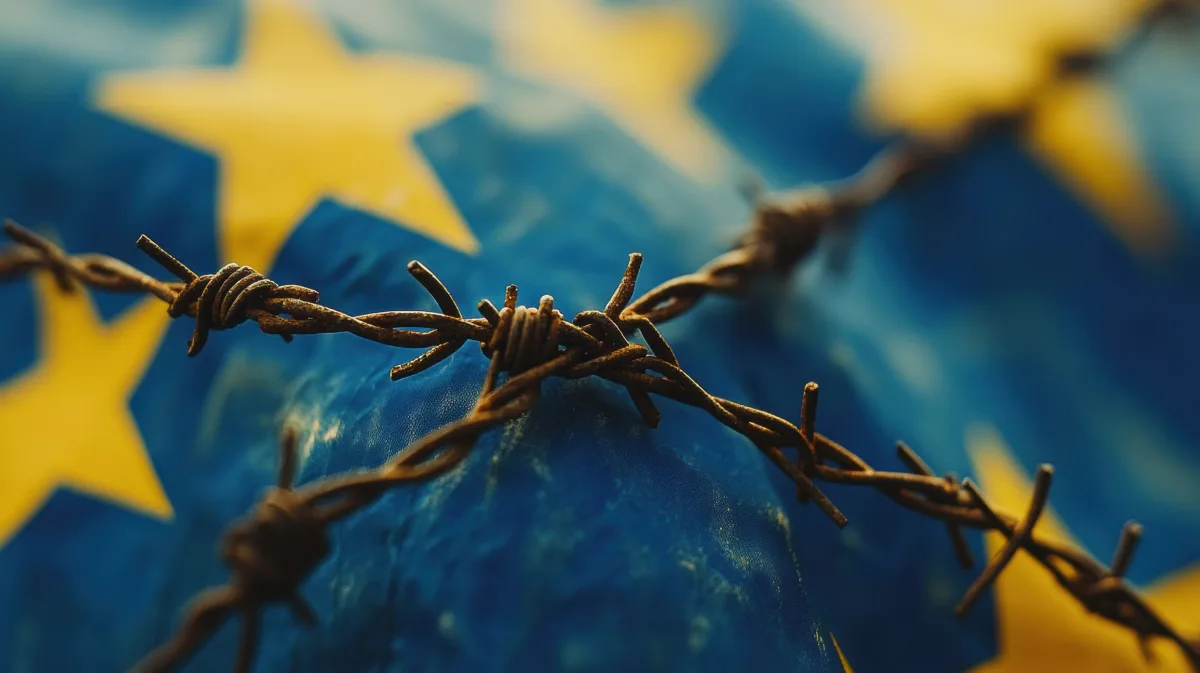
When Elon Musk called for the European Union to be ‘abolished’ after Brussels slapped a 120 million euros fine on his social media platform X, he had company. Russia’s Dmitry Medvedev replied ‘Exactly’. Sovereigntists from Budapest to Rome nodded along. China probably grinned. All of them fancy the same outcome: Europe carved back into nation-states, easier to bully, simpler to exploit, lacking collective muscle.
Fine. Grant them their wish. It’s Tuesday morning, call it Day Zero. The European Union no longer exists. No dissolution treaty, no transition, no Michel Barnier flying about negotiating exit terms. Twenty-seven countries just wake up ‘sovereign’. What happens?
Start with the unglamorous bits. The first casualties aren’t abstract notions like ‘European identity’ or ‘pooled sovereignty’. They’re people trying to catch a flight home.
At Europe’s airports, things get messy fast. The European Common Aviation Area that allowed any EU airline to fly to and from any airport in any member state has gone. The Single European Sky framework that managed 22,500 daily flights across Europe has also become obsolete. Airlines start ringing their lawyers to determine which pre-existing bilateral treaties might still apply. Few, if any, do.
Ryanair’s 9.99 euros flight from Berlin to Kraków isn’t just delayed, it’s illegal. The entire budget carrier model—planes registered in Ireland, crews from Poland, passengers from everywhere—stops working when jurisdictions no longer talk to each other. Passengers stranded at Dublin and Athens airports discover travel insurance covers acts of God, not acts of populist stupidity.
Meanwhile the roads are gridlocked. Last year, European trucks moved 1.9 trillion tonne-kilometres of freight. That number heads rapidly towards zero as impromptu barbed wire fences and customs posts materialise at every border. Polish hauliers handle nearly 20 per cent of EU freight. Suddenly their trucks are parked in lay-bys from Brandenburg to Bavaria, their paperwork invalid, their loads going nowhere.
Remember ‘frictionless borders’? It turns out that wasn’t Brussels waffle. Seven-tenths of international freight moves by road. It depends entirely on not stopping. Just-in-time manufacturing becomes just-too-late bankruptcy.
Economic damage spreads quickly
Give it a fortnight and medicine cabinets start looking sparse. Pharmaceutical supply chains were already fragile. Now they snap. Active ingredients used to flow through multiple EU production sites to patients. Hospitals face critical shortages that were bad enough with EU coordination. Without it? Medieval.
Community pharmacists normally sort out shortages 92 per cent of the time by sourcing across borders. They can’t do that now. Cancer patients miss chemotherapy. Diabetics ration insulin. That horseshoe crab blood that tests over half of injectable medicines? Always in short supply, it is now impossible to allocate between 27 countries all hoarding what little they have.
The economic damage spreads quickly. The 17.1 trillion euros single market, 15 per cent of global trade, splinters into 27 separate economies. Economists believe trade between EU members runs 3.2 times higher than between comparable non-EU countries. That premium disappears immediately. The three trillion euros in annual goods trade built up over decades hits walls—literal customs barriers at every border.
Within three months living standards crater. The single market added roughly nine per cent to EU GDP. Take it away and you subtract those gains. Families will need to choose between heating and food. Businesses will close. Some 11.3 million people work in an EU country other than their own. They’re suddenly illegal immigrants or unemployed. Or both.
Who wins? Russia, obviously. Moscow watches European unity crumble with satisfaction. China too.
For Europe’s nationalists, sovereignty exercised alone turns out to be rather less sovereign than advertised. Hungary negotiating digital policy with Beijing one-on-one? It gets steamrollered. Poland’s manufacturers without access to cross-border supply chains worth billions? They’re cottage industries now, not industrial champions.
Poorer, smaller, and far less relevant
This isn’t about ‘European values’ or federalist philosophy. It’s about Paula in Porto getting asthma medication. Jürgen in Stuttgart delivering parts to Kraków. Ewa in Warsaw visiting her daughter in Berlin. The EU, bureaucratic and regulation-obsessed as it is, made those things easy. Without it they’re expensive, complicated, sometimes impossible.
Musk’s 120 million euros fine looks rather quaint in this context. He celebrates regulatory freedom right up until his European customers can’t afford his cars because incomes have collapsed, and 27 different technical standards apply to his vehicles. Abolishing the EU sounded clever on social media. It turns out there were consequences.
Europe survives without the EU, obviously. Just poorer, smaller, and far less relevant. The sort of place that takes instructions from Beijing and Moscow rather than setting its own terms.
By lunchtime on Day Zero, sovereigntists not on the Kremlin’s payroll will realise their mistake (those who are will be jubilant). Musk’s timeline is probably longer—he’ll work it out only when Tesla’s share price craters along with the European car market. But too late. Hundreds of thousands are stranded at airports. Millions are unemployed. Supply chains built over decades are unravelling.
The EU’s political enemies understand this perfectly. That’s why they want it gone. Not for sovereignty or democratic accountability—those are just the sales pitch. A divided Europe is a weak Europe. Easier to exploit, simpler to pressure, cheaper to buy off one country at a time.
Musk’s 120 million euros fine? In hindsight, it was the bargain of the century. He just didn’t have the wit to realise it.
Photo: Dreamstime.