




two-speed europe
Fast and furious
A new deal for the 4IR
parallax background

Ready for nothing

The more organisations talk about being 'future-ready', the less they actually change

February 26, 2026

5 min read

February 26, 2026

5 min read

Photo: Dreamstime.

Everyone, it seems, is future-ready. The IMD Future Readiness Indicator now ranks 182 companies across six industries. Consultancies flog ‘future-readiness assessments’. LinkedIn groans with executives who’ve wedged the phrase into their bios, usually between ‘thought leader’ and ‘change agent’.

Buzzwords come and go, but this particular one has developed a life of its own, becoming a comfort blanket that signals the end of thinking, not the start of change. When a company declares itself future-ready, it’s often announcing, without quite realising, that it has stopped reinventing itself altogether.

From aspiration to alibi

Once, the concept actually meant something. When Austrian American management consultant Peter Drucker and his contemporaries banged on about preparing for discontinuity, readiness implied building new capabilities under genuine uncertainty. Tolerating expensive experiments. Asking uncomfortable questions about which bits of the business model ought to be taken out and shot.

Then readiness drifted from capability to credentialing. It became something to be certified, badged, benchmarked. You can trace the shift in corporate communications: ‘ready’ has migrated from strategic plans (where it once flagged capability gaps) to annual reports (where it now burnishes reputation). The grammar tells you everything. ‘We need to be ready’ has given way to ‘we are ready’. The journey became the destination.

This drift changes behaviour. When readiness was aspirational, it licensed discomfort—gave executives cover to challenge the core business, to cannibalise profitable lines, to pour money into ventures that wouldn’t show returns for years. Readiness-as-alibi does the opposite. It reassures boards that management has everything under control. That the future, whatever it brings, has already been pencilled into the spreadsheet.

The measurement trap

All those readiness indices have made things worse. IMD’s indicator ranks companies on seven factors including financial fundamentals, research and development spend and workforce diversity. It’s methodologically sophisticated, produced by serious academics. It is also, inevitably, backward-looking.

Pharma giant Pfizer ranked first in IMD’s 2022 indicator—crowned most future-ready in its sector. By 2024 it had tumbled to ninth. Covid revenues collapsed from 57 billion US dollars in 2022 to eight billion US dollars two years later. The share price, which peaked at 61 US dollars in late 2021, now bumps along around 25 US dollars. Pfizer’s response has not been reinvention but cost-cutting: a four billion US dollars realignment programme, hundreds of redundancies, shuttered sites.

None of this indicts IMD’s methodology. It measures what can be measured. That’s precisely the trap. Indicators that reward stability and accumulated capability necessarily discount the messy, destructive work of genuine reinvention. A company preparing to cannibalise its core would score terribly on short-term financials—even as it positions itself to survive.

The indices have spawned a new strain of Goodhart’s Law. Once readiness becomes a metric, chasing the score crowds out the behaviours the score was meant to capture. Companies assemble future-readiness task forces, hire chief future officers, commission readiness audits. None of which requires changing anything fundamental.

The readiness fallacy

The deepest trouble with readiness is conceptual. The word assumes a knowable future you might prepare for. That made sense in slower industries where competitive dynamics shifted over decades. It makes rather less sense now.

Notice how differently companies talk when they’re actually reinventing themselves. Netflix, which has pivoted three times—DVD rental to streaming to original content—explicitly rejects readiness-speak. Reed Hastings, its co-founder, talks instead of ‘constant reinvention’. The culture assumes the current business model is temporary. Adequate performance—being ready enough—gets you sacked.
reinvention-rediness-report-Reinvention-gap-mockup-1

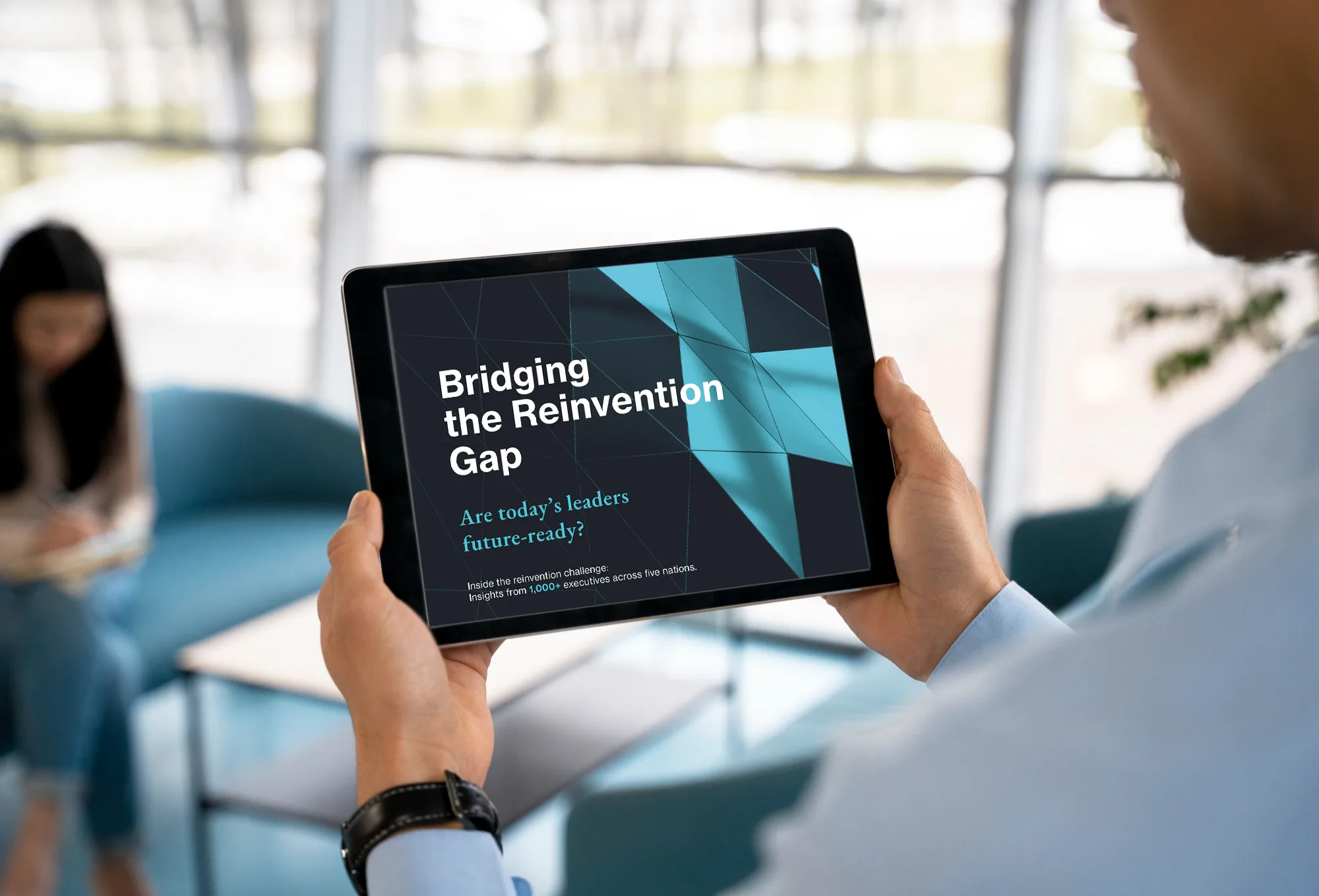
Bridging the Reinvention Gap

60-70% of change initiatives fail. You can avoid the same fate with one read. Download our data-driven roadmap for leaders who want to stop firefighting and start leading reinvention

Readiness implies preparation for a future that will arrive. Reinvention implies participation in a future being created. Ready organisations wait; reinventing ones act. Ready organisations polish existing capabilities. Reinventing ones ask whether those capabilities will matter in five years.

The distinction shows up in how capital gets allocated. Ready organisations hedge: they maintain optionality, diversify across scenarios, keep powder dry for opportunities that may never come. Reinventing organisations commit: concentrated bets, acceptance that some will fail spectacularly, suspicion that diversification signals strategic confusion rather than prudence.

Retiring the word

What might take its place? Probably not another noun. Organisations that navigate real discontinuity tend to speak in verbs: unlearn, divest, rewire, experiment. These words resist completion. You can’t be ‘unlearned’ or ‘divested’ the way you can be ‘ready’. The work never finishes.

This matters beyond linguistic tidiness. The verbs carry different accountability. A chief executive who declares the organisation future-ready has made a claim impossible to falsify until it’s too late. One who commits to specific acts of unlearning or divestment has made a claim testable by the next earnings call.

Perhaps the most telling sign of genuine reinvention is that organisations doing it rarely claim readiness for anything. They describe themselves, with varying degrees of discomfort, as perpetually incomplete. ‘Future-ready’ belongs to the vocabulary of reassurance—the language executives reach for when they want to sound bold without doing anything disruptive.

The most resilient outfits have grasped something the readiness-industrial complex hasn’t. In a world of genuine uncertainty, the feeling of being ready is usually a warning sign. It means you’ve stopped asking hard questions. Mistaken preparation for a known threat for preparation for the unknown.

It means you’re ready for nothing at all.

Photo: Dreamstime.

Reinvantage Insight

Reinvantage Insight

The byline Reinvantage Insight is used to denote articles to which several members of the Reinvantage insight and analysis team may have contributed.

Share

Case study: Global technology company

1. The Client

A global technology company operating across EMEA, with a regional HQ in Istanbul. The company manages 20+ markets, handling everything from brand campaigns to strategic partnerships.

Role we worked with: The EMEA Head of Marketing (supported by two regional managers).

2. The Challenge

Despite strong products and a respected global brand, the regional team was struggling with:

  • Misaligned strategy across markets → campaigns executed with inconsistent narratives.
  • Slowed growth → lead generation plateaued despite increasing spend.
  • Internal friction → marketing, sales, and product teams disagreed on KPIs and priorities.

Traditional fixes (more meetings, more reporting) only created more noise.

3. The Sprint

We ran a 10-day Remote Reinvention Sprint with the regional HQ team.

  • Day 1–3: Intake → Reviewed decks, campaign data, and plans.
  • Day 4: Sprint Session (90 mins) → Breakthroughs:
    • Sales and marketing had different definitions of “qualified lead.”
    • 40% of spend was going into low-potential markets.
    • The team assumed the problem was lack of budget, but it was actually lack of alignment.
  • Day 5–10: Synthesis → Insights distilled into a Clarity Brief + Insight Canvas.
4. The Breakthrough

The Sprint uncovered that the issue wasn’t budget, but fragmentation.
Three sharp insights unlocked a way forward:

  1. Unified KPIs bridging marketing + sales.
  2. Market prioritisation → shifting budget to 5 high-potential markets.
  3. Simplified narrative → one EMEA core story, locally adaptable.
By just realigning resources and focus, the client could unlock an estimated £250,000 in efficiency gains within the next 12 months — far exceeding the Sprint’s value guarantee. The path to higher returns was already inside the business, hidden by misalignment.
5. From Sprint to Action (4 Pillars Applied)

With clarity secured, Reinvantage didn’t suggest “more projects.”

Instead, we used the Sprint findings to create laser-focused next steps — drawing only from the areas that would deliver the most impact:

  • Readiness → Alignment workshops for sales + marketing teams. New playbooks clarified “qualified lead” definitions and reduced internal disputes.
  • Foresight → A market-opportunity scan identified which 5 countries would deliver the highest ROI, removing the guesswork from allocation.
  • Growth → Guided the reallocation of €2M budget and designed a phased rollout strategy that protected risk while maximising return.
  • Positioning → Built a messaging framework balancing global consistency with local nuance, ensuring campaigns spoke with one clear voice.

Because the Sprint had stripped away noise, these actions weren’t generic consulting ideas — they were directly tied to the breakthroughs.

6. The Results
  • +28% increase in qualified leads across the region.
  • 30% faster campaign rollout due to streamlined approvals.
  • Budget efficiency gains → €2M redirected from low-return to high-potential markets.
  • Internal cohesion → marketing + sales now use a single shared dashboard.
The client came in believing they needed more budget.
The Sprint revealed that what they really needed was clarity and alignment.

With that clarity, the four pillars became not theory, but practical tools to deliver measurable impact.

The Sprint guaranteed at least £20,000 in value — but in this case, it helped unlock more than 10x that within six months.

Case study: Regional VC fund & accelerator

1. The Client

A regional venture capital fund and accelerator focused on early-stage tech start-ups in the Baltics and Central Europe.

The fund had raised a new round and was under pressure to deliver stronger returns while also building its reputation as the go-to platform for founders.

Role we worked with: Managing Partner, supported by the Head of Portfolio Development.

2. The Challenge

Despite a promising portfolio, results were uneven.

Key issues:

  • Scattered portfolio support → no consistent playbook for start-ups, every partner did things differently.
  • Weak differentiation → founders and co-investors saw the fund as “one of many” in the region.
  • Stretched team → too many small bets, not enough clarity on which companies to double down on.

The leadership team knew something was off, but disagreed on whether the issue was pipeline quality, market conditions, or internal capacity.

3. The Sprint

We ran a 10-day Remote Reinvention Sprint with the partners and portfolio team.

  • Day 1–3: Intake → Reviewed pitch decks, pipeline funnel data, and start-up performance reports.
  • Day 4: Sprint Session (90 mins) → Breakthroughs:
    • No shared definition of a “high-potential founder.”
    • Support resources were spread too thin across the portfolio.
    • The fund’s positioning was more reactive than proactive — it didn’t own a distinctive narrative in the market.
  • Day 5–10: Synthesis → Insights consolidated into a Clarity Brief + Insight Canvas.
4. The Breakthrough

The Sprint revealed that the challenge wasn’t pipeline quality — it was lack of focus and positioning.

Three core insights provided the turning point:

  1. Portfolio Prioritisation Framework → defined clear criteria for where to double down.
  2. Founder Success Playbook → standardised support model for portfolio companies.
  3. Differentiated Narrative → repositioned the fund as “the accelerator of reinvention-ready founders.”
These shifts alone gave the fund a path to add an estimated £2M+ in portfolio value over the following 18 months, by concentrating capital and resources where they could move the needle most.
5. From Sprint to Action (4 Pillars Applied)

With clarity from the Sprint, Reinvantage created a tailored support plan:

  • Readiness → Coached partners on using the new prioritisation framework and trained the team on deploying the Founder Success Playbook.
  • Foresight → Ran scenario analysis on regional tech trends, helping the fund anticipate where capital would flow next.
  • Growth → Guided resource reallocation across the portfolio and supported new co-investor pitches for top-performing start-ups.
  • Positioning → Crafted a sharper brand story for the fund, positioning it as the reinvention partner for globally minded founders.
6. The Results
  • 10 portfolio companies onboarded to the new Playbook → greater consistency of support.
  • Raised follow-on capital for 3 top start-ups with the new prioritisation framework.
  • +26% increase in inbound deal flow from founders citing the fund’s new positioning.
  • Stronger internal cohesion → partners aligned on where to focus resources.
The client thought the problem was pipeline quality.
The Sprint showed it was actually lack of clarity and focus inside the firm.

By applying the four pillars, Reinvantage helped turn scattered effort into concentrated value creation.

The Sprint guaranteed at least £20,000 in value; here it set the stage for multi-million-pound upside in portfolio growth.

Case study: International impact Organisation

1. The Client

A large international impact organisation focused on entrepreneurship and economic empowerment.
The organisation runs multi-country programmes across Eastern Europe and Central Asia, often in partnership with global donors and corporate sponsors.

Role we worked with: Senior Programme Director, responsible for regional coordination.

2. The Challenge

The organisation had launched a flagship regional initiative supporting women entrepreneurs, but the programme was underperforming.

Key issues:

  • Fragmented delivery → each country office interpreted the programme differently.
  • Donor frustration → reporting lacked consistency and clear impact metrics.
  • Lost momentum → staff energy was spent on administration rather than scaling success stories.

Traditional programme reviews had produced long reports, but no real alignment or action.

3. The Sprint

We ran a 10-day Remote Reinvention Sprint with the regional leadership team and representatives from two country offices.

  • Day 1–3: Intake → Reviewed donor reports, programme KPIs, and field feedback.
  • Day 4: Sprint Session (90 mins) → Breakthroughs:
    • Donors cared about quantifiable outcomes, but reporting focused on stories.
    • Staff were duplicating efforts across countries, wasting time and resources.
    • The initiative lacked a clear theory of change — everyone described its purpose differently.
  • Day 5–10: Synthesis → Insights distilled into a Clarity Brief + Insight Canvas.
4. The Breakthrough

The Sprint revealed that the issue wasn’t donor pressure or programme design — it was a lack of shared framework and alignment.

Three critical insights reshaped the path forward:

  1. One Unified Theory of Change → agreed narrative for why the programme exists.
  2. Core Impact Metrics → clear, comparable KPIs across all countries.
  3. Smart Resource Sharing → digital hub to stop duplication and accelerate knowledge flow.
By eliminating duplicated reporting and clarifying what success looks like, the client saw they could save the equivalent of £100,000 in staff time annually — while also unlocking stronger donor confidence and follow-on funding opportunities.
5. From Sprint to Action (4 Pillars Applied)

Armed with Sprint clarity, Reinvantage proposed a laser-focused support plan:

  • Readiness → Trained programme leads on using the new metrics and integrated them into existing workflows.
  • Foresight → Analysed donor trends and expectations, aligning the initiative with the next funding cycle.
  • Growth → Developed a funding case based on the new unified theory of change, securing higher renewal chances.
  • Positioning → Crafted a regional success narrative and storytelling toolkit, helping them showcase results consistently across markets.
6. The Results
  • 30% less time spent on reporting → freed capacity for programme delivery.
  • Donor satisfaction improved → positive feedback on the clarity of impact evidence.
  • Secured new funding commitment → one major donor increased their contribution by 20%.
  • Stronger internal morale → staff felt they were working with clarity, not chaos.
The client thought it needed better donor management.
The Sprint revealed it needed a shared foundation across its teams.

By anchoring on the four pillars, Reinvantage turned alignment into efficiency gains and fresh funding opportunities.

The Sprint guaranteed at least £20,000 in value; here it unlocked both six-figure savings and future-proofed funding.

Case study: National digital development agency

1. The Client

A national digital development agency tasked with driving the government’s digital transformation agenda, including e-services, citizen portals, and smart city pilots.

Role we worked with: Director of Digital Transformation, supported by IT and service delivery leads from three ministries.

2. The Challenge

The agency had strong political backing but faced hurdles in implementation.

Key issues:

  • Siloed projects → each ministry developed digital tools independently, leading to duplication.
  • Citizen frustration → services were digital in name, but still required multiple logins and offline steps.
  • Funding pressure → international partners demanded clearer impact in the short term.

The agency wanted to accelerate momentum but struggled to get alignment across ministries.

3. The Sprint

We ran a 14-day Immersive Reinvention Sprint with the agency’s leadership and digital focal points from three ministries.

  • Day 1–3: Intake → Reviewed strategy docs, donor reports, and citizen feedback data.
  • Day 4: Immersive Sprint Session (half-day) → Breakthroughs:
    • Each ministry had different definitions of “digital service.”
    • 20% of budget was going into overlapping pilot projects.
    • Citizens’ top frustrations were known — but not prioritised.
  • Day 5–14: Synthesis → Insights consolidated into a Clarity Brief + Insight Canvas.
4. The Breakthrough

The Sprint revealed that the biggest blocker wasn’t lack of funding, but lack of shared priorities.

Three practical insights stood out:

  1. One Definition of Digital Service → agreed across ministries.
  2. Quick-Win Prioritisation → focus on top 3 citizen pain points (ID renewal, business registration, healthcare booking).
  3. Shared Resource Map → pool budgets to eliminate duplication.
These changes alone allowed the agency to unlock £75,000 in immediate savings and deliver 2–3 visible improvements in the next quarter — meeting donor expectations and building citizen trust.
5. From Sprint to Action (4 Pillars Applied)

Based on the Sprint clarity, Reinvantage proposed a modest, targeted package of support:

  • Readiness → Facilitated inter-ministerial workshops to embed the “one digital service” definition.
  • Foresight → Analysed citizen feedback trends to shape the quick-win roadmap.
  • Growth → Supported the reallocation of funds to joint projects, reducing overlap.
  • Positioning → Crafted a communication plan highlighting early digital wins to donors and citizens.
6. The Results
  • 2 pilot services integrated into the central portal (ID renewal + healthcare booking).
  • Budget savings of £75,000 from eliminating overlapping projects.
  • Citizen satisfaction up modestly → call centre complaints on digital services dropped by 12%.
  • Donor confidence improved → short-term impact report received positive feedback.
The client thought it needed more funding and bigger projects.
The Sprint revealed it first needed clarity and alignment.

By applying the four pillars to a targeted scope, Reinvantage helped deliver visible results within a single quarter — proving progress to citizens and donors and laying the groundwork for deeper transformation.

You must be logged in to view this page. Login here.

Bridging the Reinvention Gap: Fill this form and get your preview copy immediately.

Future of IT: Fill this form and get your preview copy immediately.

War for Talent: Fill this form and get your copy immediately.

The Voice of Ukrainian Start-ups: Fill this form and get your copy immediately.

The uncounted engine: Ukraine’s start-up rise. Fill this form and get your copy immediately.

The Investment Promotion Playbook 2025: Fill this form and get your preview copy immediately.

The Reinvention Masterclass for Start-up Founders: Join the private cohort

Beyond Borders: Join the private edition