


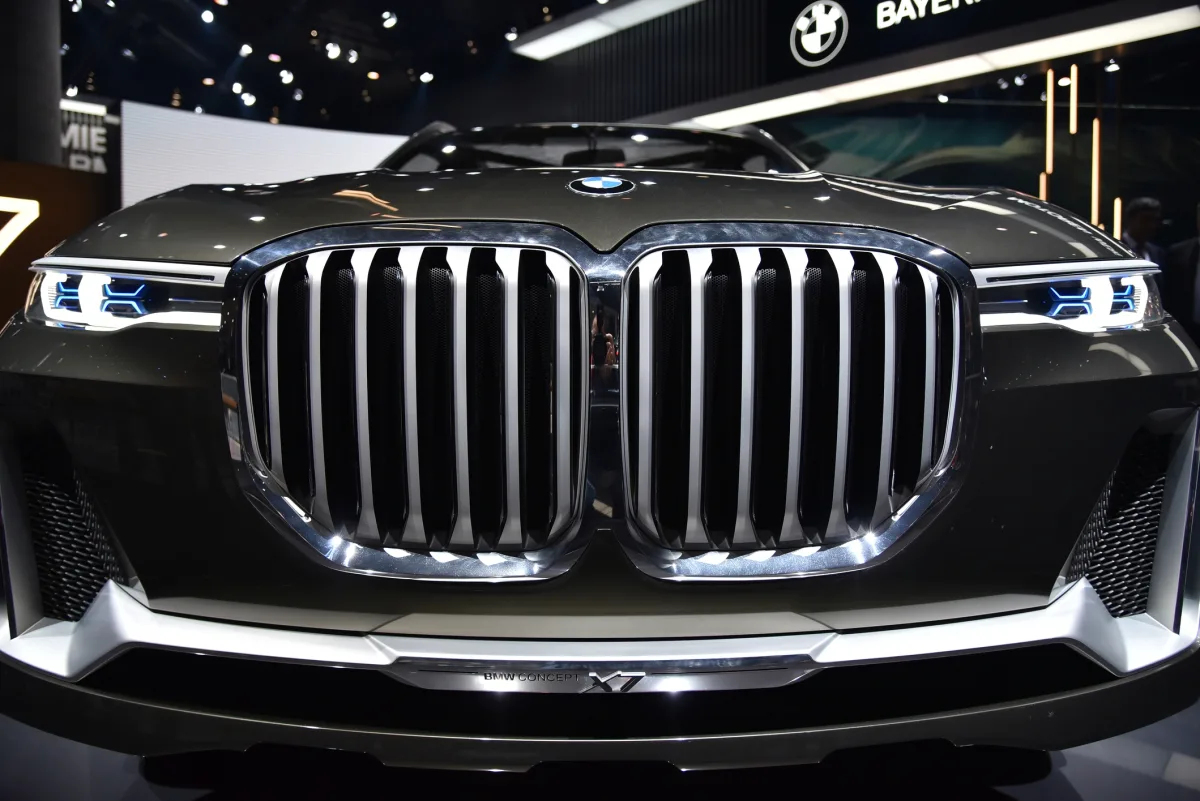
Park a BMW X7 in central Paris and the kerb will give first. The German marque’s flagship sport-utility vehicle is two metres wide without the door mirrors. The minimum on-street bay specified by Paris town hall is 1.8 metres. A study by Transport and Environment (T&E), a Brussels-based think-tank, found in January 2024 that 52 per cent of the 100 best-selling new car models in the European Union were already too wide for the standard space. The X7 has plenty of company. Mercedes-Benz’s GLS, Audi’s Q8 and the Porsche Cayenne all sit just shy of two metres. BMW’s X5, X6 and XM exceed it.
Cars have been getting fatter for years. T&E’s review of the 100 top-sellers found that the average new car widened from 177.8 cm in 2018 to 180.3 cm in the first half of 2023, growth of roughly a centimetre every two years. Data from the International Council on Clean Transportation, a Berlin-based research outfit, suggested the same trajectory had held since 2001. The European Commission, asked in early 2024 to review its width ceiling, has yet to do so. Until it acts, EU type-approval rules permit a saloon to be as wide as a coach: 2.55 metres, the same statutory maximum that applies to articulated lorries.
Governments have spent a century taxing the wrong thing about all this. Britain’s Vehicle Excise Duty, introduced in 1921, ran on engine horsepower until 1947 and on engine displacement until 2001. France swapped to carbon emissions in 2008 with its malus écologique. Norway built up a dozen overlapping levies on registration tax, weight, NOx and VAT. Each metric worked, in its fashion, as a proxy for the fuel a car burnt or the carbon it emitted. None captured the kerb space it occupied.
The omission shows. Researchers at the Insurance Institute for Highway Safety in Virginia examined 17,897 American pedestrian crashes and reported in November 2023 that vehicles with hood heights above 40 inches (101.6 centimetres) were 45 per cent more likely to cause fatalities than those with hoods of 30 inches or less. A meta-analysis by the London School of Hygiene and Tropical Medicine and Imperial College London, published in April 2025 and built on 680,000 collisions over 35 years, found that pedestrians and cyclists struck by sport-utilities or light trucks were 44 per cent more likely to die than those struck by saloons. For children, the figure was 82 per cent. For the under-tens, 130 per cent.
Streets and lay-bys, designed for the cars of an earlier age, are buckling. Lyon, France’s third city, levied a 50 per cent surcharge on residential parking permits for vehicles over 1.6 tonnes in 2024. Paris went further. In February 2024 the capital held a referendum on tripling the parking charge for sport-utilities of 1.6 tonnes or more (or two tonnes, for fully electric models) to 18 euros an hour in the inner arrondissements. The proposal passed with 54.5 per cent of the vote. Tübingen, in Baden-Württemberg, has applied a 50 per cent mark-up on residents’ parking charges for larger cars since 2022; the Association of German Cities, the country’s main municipal representative body, endorsed the approach the same year.
Weight has become the favoured proxy. France’s malus au poids, introduced in 2022 at a threshold of 1,800 kg, has dropped to 1,500 kg from January 2026; the levy starts at 10 euros a kilogram and rises to 30 euros above two tonnes. Norway has charged 12.50 krone (around 1.15 euros) per kilo of registration weight above 500 kg since January 2023, electric cars included. Both regimes punish heavy vehicles harder than light ones. Both, however, miss the externality. A 1,900-kg compact electric saloon and a 1,900-kg pickup pay the same tax under the French scheme. The saloon fits in the parking bay and over the cycle lane. The pickup does not.
Small is plentiful
Tokyo solved the problem in 1949. The kei jidōsha, or light vehicle, was created to put motoring within reach of a skint postwar population. Engines were capped at 360 cc, then 550 cc, and since 1990 at 660 cc. Length cannot exceed 3.4 metres; width, 1.48 metres; height, 2.0 metres. Owners pay 10,800 yen (around 59 euros) a year in road tax against 36,000 yen for a 1.5-litre saloon, and outside the cities are exempt from Japan’s parking-space rule (which obliges drivers to prove they have somewhere to put the vehicle before they can register it). The category has captured around 35 per cent of new car sales for over a decade, peaking at 40 per cent in 2013 before a 50 per cent rise in kei road tax took effect the following year. Honda’s N-Box, which sells around a quarter of a million units annually, has topped Japan’s sales charts for years. BYD, the Chinese electric-car maker, plans to launch a kei-compliant model for the Japanese market in late 2026.
The principle is portable. A footprint tax would charge an annual sum based on the rectangle a vehicle occupies (length multiplied by width) above a reasonable threshold. Six square metres covers a Volkswagen Golf comfortably. Above seven, the rate climbs. Above eight (which catches the BMW X7, the Range Rover and Ford’s F-150), it climbs sharply. The metric has several merits. It is technology-neutral: a Cadillac Escalade and a Hummer EV pay the same. It tracks the externality (kerb consumption, pedestrian risk, infrastructure strain) more precisely than weight, which can be skewed by battery chemistry. And it is administratively trivial. Length and width are already engraved on every type-approval certificate in the European Union.
Carmakers will hate it. A wider vehicle is a more profitable one. The Volvo EX90, replacing the XC90 in 2023, gained 4.1 cm on its predecessor. Land Rover’s reinvented Defender grew 20.6 cm. Width has long been the easiest gain in the design studio. Most buyers blanch at length but never check the figures to either side. A footprint tax would force the conversation. Two-thirds of Parisians do not own a car. The kerb in front of their flat is among the most valuable land in Europe. Whoever prices it correctly will get more pedestrians, more cyclists and more buses, and fewer Range Rovers parked across the cycle lane.
Photo: Dreamstime.