

Reinvantage Performance Diagnostic
See what may constrain your organisation’s future before it becomes visible in performance.
The Reinvantage Performance Diagnostic gives leadership an evidence-based view of the organisation’s ability to recognise change, make strategic choices and translate those choices into movement.
It reveals where existing strengths can be built upon, where institutional constraints may be narrowing options and where leaders see the organisation differently.
A clearer view of the organisation
The Performance Diagnostic examines the institutional abilities and capacities that determine whether an organisation can recognise important shifts, shape direction and adapt in practice.

Sense
Institutional ability

Shape
Institutional ability

Shift
Institutional ability
It combines evidence about the organisation itself with the pressures it is facing, so that internal capability is not interpreted in isolation from the environment in which the organisation is operating.
The result is a pattern of evidence rather than a single score.
A single score would hide too much.
Two organisations can produce similar overall results while facing very different realities.
One may struggle to recognise emerging shifts. Another may see them clearly but lack the ability to make choices, redirect resources or adapt its structures. A third may have strong capabilities overall but a specific constraint affecting something strategically important.
The Performance Diagnostic therefore interprets patterns across the organisation rather than reducing them to one maturity rating.
Leadership perception gap
Leadership perception is part of the evidence.
Senior leaders do not always see the organisation in the same way.
The Performance Diagnostic shows where perceptions converge and where material differences exist across leadership. Those differences may point to competing assumptions, fragmented visibility, uneven experience of organisational reality or different interpretations of the pressures the organisation is facing.
The purpose is not to decide which leader is right. It is to identify where divergence may itself be making coordinated action harder.
Urgency of change
Clarity of priorities
Capacity to execute
Readiness to move resources
Illustrative representation of divergence patterns; actual readings are specific to each leadership team.
The Reality Map brings the evidence together.
The Performance Diagnostic does more than identify individual strengths and weaknesses. The Reality Map shows what pressure the organisation is facing, what is happening inside the institution and whether the organisation currently has the capacity to respond.
Three kinds of evidence
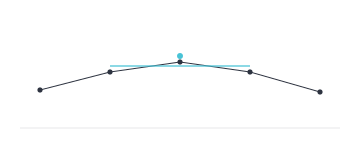
Enablers
Capacities that are currently supporting renewal and coordinated movement.
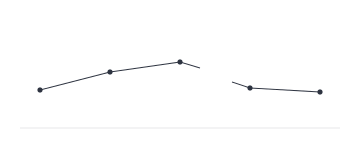
Constraints
Conditions that may be limiting the organisation’s ability to respond, decide, allocate, execute or learn.
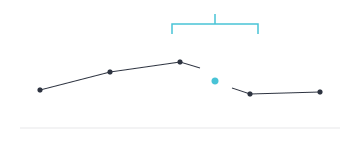
Priority Zones
Areas where a material constraint is affecting something important enough to require leadership attention.
A Priority Zone is not simply the weakest score. It is where a constraint is having significant institutional consequence.
The Reality Map helps leadership see not only where a constraint exists, but why it matters in the context of the organisation’s priorities and environment.
The Performance Diagnostic establishes where to begin.
Leadership reviews the evidence together, decides what is strategically significant and agrees where action is justified.
The Performance Diagnostic does not prescribe a standard intervention. Where deeper work is required, the evidence becomes the basis for defining what needs to change and where Reinvantage should focus.

Evidence

Alignment

Architecture

Activation

Capability
The intervention follows the evidence rather than being chosen in advance.
When the Performance Diagnostic is useful
The Performance Diagnostic is designed for organisations facing an important performance, growth or strategic question without yet having a sufficiently clear view of what inside the institution is shaping the result.
The organisation does not need to arrive with the diagnosis already understood. Establishing what sits beneath the visible issue is part of the work.
- growth or revenue is not developing as expected
- a major strategic priority is not translating into the progress leadership expected
- the organisation is struggling to scale
- leadership is uncertain about what needs to change
- leaders see the situation differently
- external pressure is increasing but the organisational implications are unclear
- a new opportunity requires capabilities or structures the organisation may not yet possess
See where the organisation has room to act.
The Performance Diagnostic gives leadership a clearer basis for deciding what to strengthen, what may need to change and where acting earlier could preserve or create strategic options.